10/15/2010

Talks between Medvedev and Chavez begin in Kremlin

Russian President Dmitry Medvedev (right) is holding talks with his Venezuelan counterpart Hugo Chavez


MOSCOW, October 15 (KATAKAMI / Itar-Tass) -- Russian President Dmitry Medvedev is holding talks with his Venezuelan counterpart Hugo Chavez in the Kremlin. Hugo Chavez arrived in Moscow for a visit on Thursday. 

At present, the talks are being held in the narrow format behind closed doors. 

As is expected, the Moscow meetings will yield a plan of action which will be the basis for cooperation up to 2014. 

The document lists specific cooperation guidelines in such spheres as foreign policy, financial sector, oil and gas industry, military-technical cooperation, nuclear power engineering, telecommunications, agriculture, fishing, transportation, education, health care, tourism, sport, culture, and elimination of natural calamities aftermath.

Michelle Obama more popular than US President

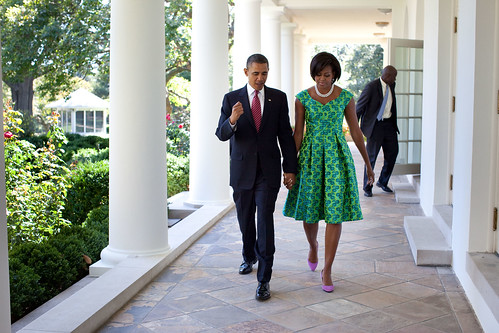
President Barack Obama and First Lady Michelle Obama walk along the Colonnade of the White House, Sept. 21, 2010. (Official White House Photo by Pete Souza)


October 15, 2010 Washington (KATAKAMI / Spicezee.Zeenews.Com) : The US First Lady, Michelle Obama’s approval ratings have soared to 65 percent, twenty points higher than the president, according to a CNN/Opinion Research Corporation poll.


According to the Daily Mail, Michelle Obama is seen as a saviour for the Democratic party, and her popularity among voters and candidates has given the Democrats a boost ahead of next month’s mid-term elections.

The survey results also revealed that six out of ten men and more than seven out of ten women approve of Michelle Obama’s performance as First Lady.

Republicans are much cooler on the First lady, with 39 percent approving and 46 percent disapproving.

CNN Polling Director Keating Holland said, “Not surprisingly, Mrs. Obama is extremely popular among Democrats, but she is also well-liked among independents.”


Michelle’s popularity has reportedly attracted the congressional candidates so much that they expressed more excitement at the prospect of campaigning with her than with Barack Obama.

When President Obama visited Wisconsin to talk up Democrat Senator Russ Feingold last month, the election hopeful’s support plunged 5 percent overnight, but after Michele’s trip to the same state on Wednesday, his popularity spiked to its highest level of his campaign and she helped him raise more than 150,000 dollars (240,000 pounds), the paper said.

Several Democrat candidates have aired TV adverts highlighting votes in Congress where they have opposed the White House, while few others have reportedly urged the president’s office that they would prefer it if Barack Obama stayed away, the paper added.

While President Obama is facing criticism for failing to bring America out of a prolonged economic crisis, Michele is acting as the first cheerleader to improve her husband’s image.

President Yudhoyono gives assurance to build shelters for Wasior flood victims


Indonesian army soldiers carry a flood victim to the hospital in Wasior village of Indonesia's Papua province October 9, 2010. At least 126 people died, 66 went missing and more than 800 injured after flash floods swept Wasior on October 4, according to data from Indonesia's National Disaster Mitigation Agency on Saturday. (REUTERS/Beawiharta)


October 15, 2010 (KATAKAMI / THE JAKARTA POST ) --- President Susilo Bambang Yudhoyono gave assurance in Manokwari that the government will build temporary shelters to accommodate thousands of victims of major flooding, which recently hit Wasior in West Papua.

“The government has been determined to build the temporary shelters,” the President said at Rendani airport on Friday as quoted by Antara.

Yudhoyono was in Manokwari on his way to go back to Jakarta after visiting the flood site for two days and meeting with the victims.

He said that the temporary shelters will be much better that the existing temporary accommodation used by the victims.

Data at the National Disaster Mitigation Agency shows that at least 4,771 people have been displaced by the flooding and they are now accommodated at several locations in Manokwari.

Indonesian Police Chief thanks House for endorsing Timur Pradopo

http://katakaminewsindonesia.files.wordpress.com/2010/10/timur-bhd.jpg
Comr.Gen.Timur Pradopo (left) an General Bambang Hendarso Danuri (right)


October 15, 2010 ( KATAKAMI / THE JAKARTA POST) --- The National Police chief Gen. Bambang Hendarso Danuari on Friday lauded that the House of Representatives’ legal commission for declaring Comr. Gen. Timur Pradopo eligible to replace his post.

Bambang praised the House’s Commission III on legal and human rights’ positive stance during Timur’s fit-and-proper test on Thursday.

“Thanks God, the test went well and I really appreciate the Commission members for accepting (Timur’s nomination),” Bambang said Friday morning during his work visit to Manokmari, West Papua, as quoted by Kompas.com.

Bambang said that he welcomed criticism raised by some legislators, saying it was a good input for the betterment of the police institution. He also hoped Timur could perform well in carrying his upcoming tasks.

During the interview, the Indonesian Democratic Party of Struggle (PDI-P) Faction and the National Mandate Party (PAN) demanded the police to stay independent and professional, respect diversity, fight against violence act and settle troubled Bank Century case immediately.

President Susilo Bambang Yudhoyono nominated Timur as the sole candidate at the last minute, refusing to select two candidates – general monitoring inspector Comr. Gen. Nanan Sukarna and training and education institutions chief Comr. Gen. Imam Sujarwo – proposed by Bambang.

Bambang will retire from his post by end of this month.

Thatcher sorry for missing party

FILE : British Prime Minister David Cameron greets former Prime Minister Baroness Thatcher on the steps of Number 10 Downing Street on June 8, 2010 in London, England. Baroness Thatcher served as Prime Minister of the UK from 1979 to 1990.
(June 7, 20102010-06-07 16:00:00 - Photo by Oli Scarff/Getty Images Europe)


October 15, 2010 (KATAKAMI / THE SCOTSMAN.COM) --- Baroness Thatcher last night sent her apologies to guests after illness forced her to miss a Downing Street reception to mark her 85th birthday.

The former prime minister expressed her disappointment in a message read out to a gathering of 150 friends and colleagues at the event, hosted by David Cameron.
 
But she also made light of the bout of flu that prompted her absence, playing on her famous phrase that the "lady's not for turning".

"After all the trouble that everyone has been to, I am so disappointed not to be with you this evening," Lady Thatcher wrote.

"I want to thank the Prime Minister and everyone present for your understanding.

"I hope that you will appreciate that on this particular occasion I have had to accept that the lady is not for returning. Please, please enjoy yourselves."

Lady Thatcher had insisted the gathering go ahead despite her last-minute withdrawal.

Mr Cameron announced he was hosting the event at the Conservative Party conference last week, when he was cheered by delegates for hailing the peer as "the greatest peacetime prime minister of the 20th century".
He first invited Lady Thatcher to N0 10 soon after he became Prime Minister earlier this year.

Photostream : British Prime Minister David Cameron meets Governor of California Arnold Schwarzenegger

(Number 10 Gov.UK) Governor Schwarzenegger meets PM at Number 10

British Prime Minister David Cameron (C), reacts as he prepares to greet the Governor of California, Arnold Schwarzenegger, on the steps of 10 Downing Street, in central London, on October 14, 2010. (AFP PHOTO/CARL COURT)

British Prime Minister David Cameron (L), gestures as he poses for photographers with the Governor of California, Arnold Schwarzenegger, on the steps of 10 Downing Street, in central London, on October 14, 2010. (Photo : Carl Court/AFP/Getty Images)

Britain's Prime Minister David Cameron (R) talks to the Governor of California, Arnold Schwarzenegger, inside number 10 Downing Street, October 14, 2010 in London. Mr Cameron and Mr Scwarzenegger will meet British troops later today at Wellington Barracks in central London. (Photo by Stefan Wermuth - WPA Pool/Getty Images)

British Prime Minister David Cameron (R) watches as Governor of California Arnold Schwarzenegger (C) talks to soldiers at Wellington Barracks on October 14, 2010 in London, England. (Photo by Peter Macdiarmid/Getty Images)

British Prime Minister, David Cameron reacts as Governor of California, Arnold Schwarzenegger makes a joke about having watched the troops training in the gym, during a visit to The Wellington Baracks on October 14, 2010 in London, England. (Photo by Leon Neal - WPA Pool/Getty Images)

Britain's Prime Minister David Cameron (2nd L) talks with soldiers during a visit with the Governor of California, Arnold Schwarzenegger, to Wellington Barracks, in central London on October 14, 2010. ( REUTERS/Leon Neal/Pool )

First 3 Chilean miners head home from hospital


Andre Sougarret (3rd L), chief of the rescue mission, poses with miners Daniel Herrera (L), Jose Ojeda (4th L), Jorge Galleguillos (4th R), Ariel Ticona (3rd R), Alex Vega (2nd R), and Claudio Yanez, and other members of the rescue team during a meeting in the Copiapo Hospital in Copiapo, Octobeer 14, 2010. Chile's 33 rescued miners recovered from their two-month ordeal on Thursday as the offers and gifts that go along with their new celebrity status started to roll in, including an invitation to Graceland. (REUTERS/Codelco/Handout )


The first three miners left the hospital late Thursday night as all now known as "los 33" began their unfamiliar new lives as national heroes. 

Chilean TV showed miner Edison Pena, plucked 12th from the cavern where they were trapped for more than two months a half mile underground, getting out of the hospital in Copiapo first.

All three miners, still wearing their shades, piled into an SUV bound for home, smiling and waving.
"I didn't think I'd make it back, so this reception really blows my mind," said Pena, 34, as waiting neighbors showered him with confetti. Triathlete Pena ran 6 miles a day down in the mine tunnel in the days after the collapse to cope with the stress.

"We really had a bad time," he added, before ducking into his home and closing the front door.
All the miners got tastes of what awaits: swarms of reporters, TV producers, publicity agents and even soccer teams all desperate for a piece of their story.

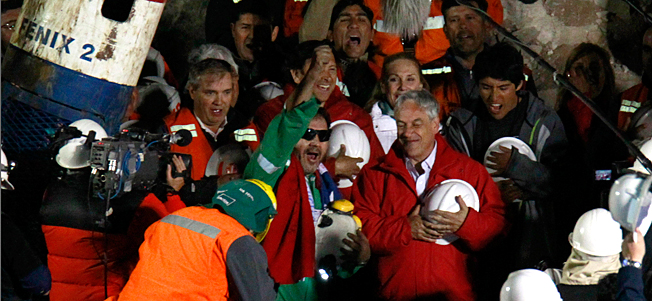
The men posed in hospital bathrobes for a group photo with President Sebastian Pinera.

Unity helped the men for 69 days underground, including more than two weeks when no one knew whether they were alive.

But the moment they walk out the hospital doors, they'll go beyond the reach of a government operation that has cared for, fed and protected them in a carefully coordinated campaign to ensure each of them would leave in top condition.

"Now they're going to have to find their equilibrium and take care of themselves," the hospital chaplain, the Rev. Luis Lopez, told The Associated Press.

They got quite the preview Thursday of what lies ahead. On their first full day of fresh air, the miners were probably the 33 most in-demand people on the planet.

A Greek mining company wants to bring them to the sunny Aegean islands, competing with rainy Chiloe in the country's southern archipelago, whose tourism bureau wants them to stay for a week.

Soccer teams in Madrid, Manchester and Buenos Aires want them in their stadiums. Bolivia's president wants them at his palace. TV host Don Francisco wants them all on his popular "Sabado Gigante" show in Miami.

Hearing that miner Edison Pena jogged regularly in the tunnels below the collapsed rock, the New York City marathon invited him to participate in next month's race.

What about a reality show? Some other kind of TV work? Why not, said television writer-producer and Oscar nominee Lionel Chetwynd, who said he expected projects were being pitched around Hollywood within hours of the rescue.

"Television is a quick-response medium," he said, joking: "In fact, I think I'll call my agent when we get off the phone."

Doctors said the other miners would get out of the hopital Friday and over the weekend.

Their families and friends were organizing welcome-home dinners, street celebrations and even weddings. Lilianett Ramirez, whose husband Mario Gomez promised her a church wedding in the "Dear Lila" letter Pinera read on TV when the men were found alive, said they have now set a date: "If God and the Virgin desire it, we'll get married on Nov. 7, his birthday," she said, beaming as she left the hospital.

The government promised six months of psychological treatment, made sure each has a bank account only he can operate, and coached them on dealing with rude questions.

The rescue team even asked Guinness World Records to honor all 33 with the record for longest time trapped underground, rather than the last miner out, Luis Urzua. Guinness spokeswoman Jamie Panas said the organization was studying the question.


The men certainly have an extraordinary story to tell. No one before them had been trapped so long and survived.

Pinera also was defining face of the rescue, embracing Luis Urzua when he climbed out of the pod to become the 33rd miner out, then leading a joyous crowd in the national anthem.
"They have experienced a new life, a rebirth," he said, and so has Chile: "We aren't the same that we were before the collapse on Aug. 5. Today Chile is a country much more unified, stronger and much more respected and loved in the entire world."

The billionaire businessman-turned-politician also promised "radical" changes and tougher safety laws to improve how businesses treat their workers.

"Never again in our country will we permit people to work in conditions so unsafe and inhuman as they worked in the San Jose mine, and in many other places in our country," said Pinera, who took office in March as Chile's first elected right-wing president in a half-century.

Among the most compelling stories from the ordeal will be Urzua's. He was the shift foreman when 700,000 tons of rock sealed them in. It was his strict rationing of the 48-hour food supply that helped them stay alive until help came.

Early reports on their food supply were based on memories and partial information from down below. Based on new details the miners shared Thursday with their families, the rationing appears to have been even more extreme than previously thought.

"He told me they only had 10 cans of tuna to share, and water, but it isn't true the thing about milk, because it was bad, out of date," Alberto Sepulveda said after visiting his brother Dario.

Other family members were told the tuna amounted to about half a capful from the top of a soda bottle — and that the only water they could drink tasted of oil.

"I think he was a fundamental pillar that enabled them to keep discipline," said Manuel Gonzalez, the first rescuer down and the last to leave.

"The guys that were down there, I think they never lost their hope," he added. "There were critical moments, but at the end they never lost their hope because they had very positive leaders who kept the group unified."

Readout of the President Obama’s Call with President Piñera of Chile


FILE : President Barack Obama greets Chilean President Sebastian Pinera during the official arrivals for the Nuclear Security Summit in Washington, Monday April 12, 2010. (AP Photo/Charles Dharapak)


October 14, 2010 (KATAKAMI / WHITE HOUSE GOV) — “Earlier today, President Obama called Chilean President Sebastian Piñera to congratulate him and the Chilean government on the historic rescue of the 33 miners trapped under more than 2,000 feet of rock in northern Chile since August 5.  The President hailed the rescue as a tribute not only to the determination of the rescue workers and the Chilean government, but also the miners and the Chilean people who have inspired the world.  President Piñera conveyed his thanks to the President, the United States government, and the American companies and individuals who provided support for the rescue efforts.”

US general’s promise over Linda Norgrove kidnap death

Aid worker Linda Norgrove (Photo: EPA)


October 14, 2010 (KATAKAMI / METRO.CO.UK) --- Gen David Petraeus insisted Britain would be fully involved in the inquiry into the apparent ‘friendly fire’ death.

As he met prime minister David Cameron at No.10 to give him an update, the body of Miss Norgrove arrived back in RAF Lyneham, Wiltshire. A post-mortem examination on the 36-year-old will be held before a full inquest.

Gen Petraeus discussed the case with Mr Cameron during 90 minutes of talks.

‘Gen Petraeus said the investigation was a personal priority for him and emphasised there would be full co- operation between the US and UK,’ a spokesman for Mr Cameron said.

US central command has launched an investigation after it was initially reported Miss Norgrove from the Isle of Lewis in the Outer Hebrides had been blown up by her Taliban captors. However, film footage suggests she was already clear of them when her would-be rescuers threw a grenade.

Gen Petraeus also thanked Mr Cameron for the ongoing British commitment to Afghanistan and the ‘valued contribution made by British troops’.

They agreed operations in Kandahar and Helmand province were ‘proceeding well’.

Mr Cameron also briefed Gen Petraeus on the defence review to be announced next week.

Photostream : Britain's Prime Minister David Cameron meets Commander of US and NATO forces in Afghanistan General David Petraeus


Britain's Prime Minister David Cameron , right, meets General David Petraeus, left, Commander of US and NATO forces in Afghanistan, inside 10 Downing Street, central London Thursday Oct.14, 2010. The talks in London have been overshadowed by revelations that a kidnapped British aid worker may have been killed by her American rescuers _ rather than her Taliban captors as first reported. .(Getty Images / AP Photo/ Daniel Deme, pool)

Britain's Prime Minister David Cameron (R) speaks to ISAF Commander General David Petraeus (L) at 10 Downing Street in Central London October 14, 2010. ( REUTERS/Pool/Daniel Deme )

General David Petraeus leaves 10 Downing Street after meeting with British Prime Minister David Cameron on October 14, 2010 in London, England. Petraeus, the top US commander in Afghanistan, has called for an investigation into the death of British aid worker Linda Norgrove, who was held hostage in Afghanistan. Ms Norgrove died after a failed rescue opperation by US forces on October 8, 2010 in Afghanistan. (Photo by Dan Kitwood/Getty Images)


U.S. General David Petraeus leaves Downing Street after his meeting with Britain's Prime Minister David Cameron in London October 14, 2010. ( REUTERS/Toby Melville )

General David Petraeus leaves 10 Downing Street in London Thursday, Oct. 14, 2010. British Prime Minister David Cameron raised the case of a slain British aid worker in a Downing Street meeting Thursday with NATO's top commander in Afghanistan, U.S. Gen. David Petraeus. Cameron earlier this week revealed that Linda Norgrove, a kidnapped British aid worker, may have been killed by her American rescuers _ rather than her Taliban captors as first reported. (AP Photo/Sang Tan)

Somali President Names Somali-American as Prime Minister

http://graphics8.nytimes.com/images/2010/10/15/world/africa/15somalia-photo/15somalia-photo-popup.jpg

Newly appointed Prime Minister for Somalia Mohamed Abdulahi attends a briefing at the presidential palace in Mogadishu. (Getty Images)


October 14, 2010. MOGADISHU, Somalia (KATAKAMI / NYTIMES) — The Somalian president on Thursday named a Somali-American to replace the prime minister whose resignation last month brought the weak transitional government to a standstill.

“After long consultations and prayers,” President Sheik Sharif Sheik Ahmed said at a news conference in Mogadishu, “we have succeeded in nominating the right and proper person.”

“ I hope,” President Sharif said, “that he will succeed the difficult task ahead.”

The previous prime minister, Omar Abdirashid Ali Sharmarke, resigned Sept. 21 after months of intense pressure from the president. Disputes between the two men siphoned focus from the government even as Islamic militants increased their attacks.

Despite the deployment of thousands of African Union peacekeepers to bolster the central government, the militants, the Shabab, control much of the country, including most of the capital.

The appointee, Mohamed Abdullahi Mohamed, worked in the Somali Embassy in Washington from 1985 to 1988, according to a statement on the government’s Web site, The Associated Press reported. He has a master’s degree in political science and taught conflict resolution and leadership skills at Erie Community College, in Buffalo, N.Y., The A.P. said, citing his resume.

“I am ready to work with the members of the parliament and if god wills, I will appoint the new council of ministers soon.” said Mr. Mohamed. “Security is the first priority for my government.”

Photostream : Russian President Dmitry Medvedev meets Venezuela's President Hugo Chavez


Russia's President Dmitry Medvedev (R) welcomes Venezuelan counterpart Hugo Chavez as they meet at the Gorki presidential residence outside Moscow October 14, 2010. (REUTERS/RIA Novosti/Kremlin/Dmitry Astakhov)

Russian President Dmitry Medvedev, right, greets Venezuela's President Hugo Chavez during their meeting in the Gorki residence outside Moscow, Thursday, Oct. 14, 2010. (AP Photo/RIA-Novosti, Dmitry Astakhov, Presidential Press Service,pool)

Russian President Dmitry Medvedev and Venezuela's President Hugo Chavez, right, seen during their meeting in the Gorki residence outside Moscow, Thursday, Oct. 14, 2010. (AP Photo/RIA-Novosti, Dmitry Astakhov, Presidential Press Service,pool)

Russia's President Dmitry Medvedev (R) listens to his Venezuelan counterpart Hugo Chavez as they meet at the Gorki presidential residence outside Moscow October 14, 2010. (REUTERS/RIA Novosti/Kremlin/Dmitry Astak)

10/14/2010

They're all out: 33 miners raised safely in Chile


AP/Roberto Candia )


SAN JOSE MINE, Chile (KATAKAMI / AP)  –  The last of the Chilean miners, the foreman who held them together when they were feared lost, was raised from the depths of the earth Wednesday night — a joyous ending to a 69-day ordeal that riveted the world. No one has ever been trapped so long and survived.

Luis Urzua ascended smoothly through 2,000 feet of rock, completing a 22 1/2-hour rescue operation that unfolded with remarkable speed and flawless execution. Before a jubilant crowd of about 2,000 people, he became the 33rd miner to be rescued.

"We have done what the entire world was waiting for," he told Chilean President Sebastian Pinera immediately after his rescue. "The 70 days that we fought so hard were not in vain. We had strength, we had spirit, we wanted to fight, we wanted to fight for our families, and that was the greatest thing."

The president told him: "You are not the same, and the country is not the same after this. You were an inspiration. Go hug your wife and your daughter." With Urzua by his side, he led the crowd in singing the national anthem.

The rescue exceeded expectations every step of the way. Officials first said it might be four months before they could get the men out; it turned out to be 69 days and about 8 hours.

Once the escape tunnel was finished, they estimated it would take 36 to 48 hours to get all the miners to the surface. That got faster as the operation went along, and all the men were safely above ground in 22 hours, 37 minutes.

The rescue workers who talked the men through the final hours were being hoisted one at time to the surface.


AP/Hugo Infante, Chilean government


The crowd in "Camp Hope," down a hill from the escape shaft, set off confetti, released balloons and sprayed champagne as Urzua's capsule surfaced, joining in a rousing miners' cheer. In Chile's capital of Santiago, hundreds gathered in Plaza Italia, waving flags and chanting victory slogans in the miners' honor.

In nearby Copiapo, about 3,000 people gathered in the town square, where a huge screen broadcast live footage of the rescue. The exuberant crowd waved Chilean flags of all sizes and blew on red vuvuzelas as cars drove around the plaza honking their horns, their drivers yelling, "Long live Chile!"
"The miners are our heroes," said teary-eyed Copiapo resident Maria Guzman, 45.

One by one throughout the day, the men had emerged to the cheers of exuberant Chileans and before the eyes of a transfixed globe. While the operation picked up speed as the day went on, each miner was greeted with the same boisterous applause from rescuers.

"Welcome to life," Pinera told Victor Segovia, the 15th miner out. On a day of superlatives, it seemed no overstatement.

They rejoined a world intensely curious about their ordeal, and certain to offer fame and jobs. Previously unimaginable riches awaited men who had risked their lives going into the unstable gold and copper mine for about $1,600 a month.

The miners made the smooth ascent inside a capsule called Phoenix — 13 feet tall, barely wider than their shoulders and painted in the white, blue and red of the Chilean flag. It had a door that stuck occasionally, and some wheels had to be replaced, but it worked exactly as planned.

Beginning at midnight Tuesday, and sometimes as quickly as every 25 minutes, the pod was lowered the nearly half-mile to where 700,000 tons of rock collapsed Aug. 5 and entombed the men.
Then, after a quick pep talk from rescue workers who had descended into the mine, a miner would climb in, make the journey upward and emerge from a manhole into the blinding sun.

The rescue was planned with extreme care. The miners were monitored by video on the way up for any sign of panic. They had oxygen masks, dark glasses to protect their eyes from the unfamiliar sunlight and sweaters for the jarring transition from subterranean swelter to chilly desert air.

As they neared the surface, a camera attached to the top of the capsule showed a brilliant white piercing the darkness not unlike what accident survivors describe when they have near-death experiences.

The miners emerged looking healthier than many had expected and even clean-shaven. Several thrust their fists upwards like prizefighters, and Mario Sepulveda, the second to taste freedom, bounded out and led his rescuers in a rousing cheer. Franklin Lobos, who played for the Chilean national soccer team in the 1980s, briefly bounced a soccer ball on his foot and knee.

"We have prayed to San Lorenzo, the patron saint of miners, and to many other saints so that my brothers Florencio and Renan would come out of the mine all right. It is as if they had been born again," said Priscila Avalos. One of her brothers was the first miner rescued, and the other was due out later in the evening.

Health Minister Jaime Manalich said some of the miners probably will be able to leave the hospital Thursday — earlier than projected — but many had been unable to sleep, wanted to talk with families and were anxious. One was treated for pneumonia, and two needed dental work.

"They are not ready to have a moment's rest until the last of their colleagues is out," he said.
As it traveled down and up, down and up, the rescue capsule was not rotating as much inside the 2,041-foot escape shaft as officials expected, allowing for faster trips.
 
The first man out was Florencio Avalos, who emerged from the missile-like chamber and hugged his sobbing 7-year-old son, his wife and the Chilean president.

No one in recorded history has survived as long trapped underground. For the first 17 days, no one even knew whether they were alive. In the weeks that followed, the world was captivated by their endurance and unity.

News channels from North America to Europe and the Middle East carried live coverage of the rescue. Pope Benedict XVI said in Spanish that he "continues with hope to entrust to God's goodness" the fate of the men. Iran's state English-language Press TV followed events live for a time. Crews from Russia and Japan and North Korean state TV were at the mine.

The images beamed to the world were extraordinary: Grainy footage from beneath the earth showed each miner climbing into capsule, then disappearing upward through an opening. Then a camera showed the pod steadily rising through the dark, smooth-walled tunnel.

Among the first rescued was the youngest miner, Jimmy Sanchez, at 19 the father of a months-old baby. Two hours later came the oldest, Mario Gomez, 63, who suffers from a lung disease common to miners and had been on antibiotics inside the mine. He dropped to his knees after he emerged, bowed his head in prayer and clutched the Chilean flag.

Gomez's wife, Lilianett Ramirez, pulled him up from the ground and embraced him. The couple had talked over video chat once a week, and she said that he had repeated the promise he made to her in his initial letter from inside the mine: He would marry her properly in a church wedding, followed by the honeymoon they never had.

The lone foreigner among them, Carlos Mamani of Bolivia, was visited at a nearby clinic by Pinera and Bolivian President Evo Morales. The miner could be heard telling the Chilean president how nice it was to breathe fresh air and see the stars.

Most of the men emerged clean-shaven. More than 300 people at the mine alone had worked on the rescue or to sustain them during their long wait by lowering rocket-shaped tubes dubbed "palomas," Spanish for carrier pigeons. Along with the food and medicine came razors and shaving cream.
Estimates for the rescue operation alone have soared beyond $22 million, though the government has repeatedly insisted that money is not a concern.

The men emerged in good health. But at the hospital in Copiapo, where miner after miner walked from the ambulance to a waiting wheelchair, it became clear that psychological issues would be as important to treat as physical ones.

Dr. Guillermo Swett said Sepulveda told him about an internal "fight with the devil" that he had inside the mine. He said Sanchez appeared to be having a hard time adjusting, and seemed depressed.
"He spoke very little and didn't seem to connect," the doctor said.

The entire rescue operation was meticulously choreographed. No expense was spared in bringing in topflight drillers and equipment — and boring three separate holes into the copper and gold mine. Only one has been finished — the one through which the miners exited.

Mining is Chile's lifeblood, providing 40 percent of state earnings, and Pinera put his mining minister and the operations chief of state-owned Codelco, the country's biggest company, in charge of the rescue.
It went so well that its managers abandoned a plan to restrict images of the rescue. A huge Chilean flag that was to obscure the hole from view was moved aside so the hundreds of cameras perched on a hill above could record images that state TV also fed live.

That included the surreal moment when the capsule dropped for the first time into the chamber, where the bare-chested miners, most stripped down to shorts because of the underground heat, mobbed the rescuer who emerged to serve as their guide to freedom.

"This rescue operation has been so marvelous, so clean, so emotional that there was no reason not to allow the eyes of the world — which have been watching this operation so closely — to see it," a a beaming Pinera told a news conference after the first miner safely surfaced.

The miners' vital signs were closely monitored throughout the ride. They were given a high-calorie liquid diet donated by NASA, designed to prevent nausea from any rotation of the capsule as it travels through curves in the 28-inch-diameter escape hole.

Engineers inserted steel piping at the top of the shaft, which is angled 11 degrees off vertical before plunging like a waterfall. Drillers had to curve the shaft to pass through "virgin" rock, narrowly avoiding collapsed areas and underground open spaces in the overexploited mine, which had operated since 1885.
U.S. President Barack Obama said the rescue had "inspired the world." The crews included many Americans, including a driller operator from Denver and a team from Center Rock Inc. of Berlin, Pa., that built and managed the piston-driven hammers that pounded the hole through rock laced with quartzite, some of the hardest and most abrasive rock.

Chile has promised that its care of the miners won't end for six months at least — not until they can be sure that each man has readjusted.

Psychiatrists and other experts in surviving extreme situations predict their lives will be anything but normal. Since Aug. 22, when a narrow bore hole broke through to their refuge and the miners stunned the world with a note, scrawled in red ink, disclosing their survival, their families have been exposed in ways they never imagined.

Miners had to describe their physical and mental health in detail with teams of doctors and psychologists. In some cases, when both wives and lovers claimed the same man, everyone involved had to face the consequences.

As trying as their time underground was, the miners now face challenges so bewildering that no amount of coaching can fully prepare them. Rejoining a world intensely curious about their ordeal, they have been invited to presidential palaces, to take all-expenses-paid vacations and to appear on countless TV shows. Book and movie deals are pending, along with job offers.

Sepulveda's performance exiting from the shaft appeared to confirm what many Chileans thought when they saw his engaging performances in videos sent up from below — that he could have a future as a TV personality.

But he tried to quash the idea as he spoke to viewers of Chile's state television channel while sitting with his wife and children shortly after his rescue.

"The only thing I'll ask of you is that you don't treat me as an artist or a journalist, but as a miner," he said. "I was born a miner and I'll die a miner."

Obama Salutes Chile and Rescue

U.S. President Barack Obama speaks during a Rose Garden event about the American Opportunity Tax Credit (AOTC) October 13, 2010 at the White House in Washington, DC. (Getty Images)


October 13, 2010 (KATAKAMI) — Following are comments of President Obama this afternoon in the Rose Garden, as he started a previously scheduled event about a tax credit for college education.


“This is obviously something that’s captivated the world’s attention and this rescue is a tribute not only to the determination of the rescue workers and the Chilean government, but also the unity and resolve of the Chilean people who have inspired the world. And I want to express the hopes of the American people that the miners who are still trapped underground will be returned home safely as soon as possible.

“Let me also commend so many people of goodwill, not only in Chile, but also from the United States and around the world, who are lending a hand in this rescue effort — from the NASA team that helped design the escape vehicle, to American companies that manufactured and delivered parts of the rescue drill, to the American engineer who flew in from Afghanistan to operate the drill.

“Last night, the whole world watched the scene at Camp Esperanza as the first miner was lifted out from under more than 2,000 feet of rock and then embraced by his young son and family.

And the tears they shed — after so much time apart — expressed not only their own relief, not only their own joy, but the joy of people everywhere. So it was a thrilling moment and we’re hopeful that those celebrations duplicate themselves throughout the rest of today.”


NYTimes

Last of Chilean miners is raised safely to surface

Miner Ariel Ticona Yanez, center, emerges from the capsule that lifted him to the surface after being rescued from the collapsed San Jose gold and copper mine where he had been trapped with 32 other miners for over two months near Copiapo, Chile, Wednesday Oct. 13, 2010.


SAN JOSE MINE, Chile  (KATAKAMI)  — The last of the Chilean miners, the foreman who held them together when they were feared lost, was raised from the depths of the earth Wednesday night — a joyous ending to a 69-day ordeal that riveted the world. No one has ever been trapped so long and survived.

Luis Urzua ascended smoothly through 2,000 feet of rock, completing a 22 1/2-hour rescue operation that unfolded with remarkable speed and flawless execution. Before a jubilant crowd of about 2,000 people, he became the 33rd miner to be rescued.

"We have done what the entire world was waiting for," he told Chilean President Sebastian Pinera immediately after his rescue. "The 70 days that we fought so hard were not in vain. We had strength, we had spirit, we wanted to fight, we wanted to fight for our families, and that was the greatest thing."

The president told him: "You are not the same, and the country is not the same after this. You were an inspiration. Go hug your wife and your daughter." With Urzua by his side, he led the crowd in singing the national anthem.

The rescue exceeded expectations every step of the way. Officials first said it might be four months before they could get the men out; it turned out to be 69 days and about 8 hours.

Once the escape tunnel was finished, they estimated it would take 36 to 48 hours to get all the miners to the surface. That got faster as the operation went along, and all the men were safely above ground in 22 hours, 37 minutes.
The rescue workers who talked the men through the final hours still had to be hoisted to the surface.
In nearby Copiapo, about 3,000 people gathered in the town square, where a huge screen broadcast live footage of the rescue. The exuberant crowd waved Chilean flags of all sizes and blew on red vuvuzelas as cars drove around the plaza honking their horns, their drivers yelling, "Long live Chile!"
"The miners are our heroes," said teary-eyed Copiapo resident Maria Guzman, 45.

One by one throughout the day, the men had emerged to the cheers of exuberant Chileans and before the eyes of a transfixed globe. While the operation picked up speed as the day went on, each miner was greeted with the same boisterous applause from rescuers.

"Welcome to life," Pinera told Victor Segovia, the 15th miner out. On a day of superlatives, it seemed no overstatement.

They rejoined a world intensely curious about their ordeal, and certain to offer fame and jobs. Previously unimaginable riches awaited men who had risked their lives going into the unstable gold and copper mine for about $1,600 a month.

The miners made the smooth ascent inside a capsule called Phoenix — 13 feet tall, barely wider than their shoulders and painted in the white, blue and red of the Chilean flag. It had a door that stuck occasionally, and some wheels had to be replaced, but it worked exactly as planned.

Beginning at midnight Tuesday, and sometimes as quickly as every 25 minutes, the pod was lowered the nearly half-mile to where 700,000 tons of rock collapsed Aug. 5 and entombed the men.

Then, after a quick pep talk from rescue workers who had descended into the mine, a miner would climb in, make the journey upward and emerge from a manhole into the blinding sun.

The rescue was planned with extreme care. The miners were monitored by video on the way up for any sign of panic. They had oxygen masks, dark glasses to protect their eyes from the unfamiliar sunlight and sweaters for the jarring transition from subterranean swelter to chilly desert air.

As they neared the surface, a camera attached to the top of the capsule showed a brilliant white piercing the darkness not unlike what accident survivors describe when they have near-death experiences.
The miners emerged looking healthier than many had expected and even clean-shaven. Several thrust their fists upwards like prizefighters, and Mario Sepulveda, the second to taste freedom, bounded out and led his rescuers in a rousing cheer. Franklin Lobos, who played for the Chilean national soccer team in the 1980s, briefly bounced a soccer ball on his foot and knee.

"We have prayed to San Lorenzo, the patron saint of miners, and to many other saints so that my brothers Florencio and Renan would come out of the mine all right. It is as if they had been born again," said Priscila Avalos. One of her brothers was the first miner rescued, and the other was due out later in the evening.

Health Minister Jaime Manalich said some of the miners probably will be able to leave the hospital Thursday — earlier than projected — but many had been unable to sleep, wanted to talk with families and were anxious. One was treated for pneumonia, and two needed dental work.

"They are not ready to have a moment's rest until the last of their colleagues is out," he said.
As it traveled down and up, down and up, the rescue capsule was not rotating as much inside the 2,041-foot escape shaft as officials expected, allowing for faster trips.

The first man out was Florencio Avalos, who emerged from the missile-like chamber and hugged his sobbing 7-year-old son, his wife and the Chilean president.

No one in recorded history has survived as long trapped underground. For the first 17 days, no one even knew whether they were alive. In the weeks that followed, the world was captivated by their endurance and unity.

News channels from North America to Europe and the Middle East carried live coverage of the rescue. Pope Benedict XVI said in Spanish that he "continues with hope to entrust to God's goodness" the fate of the men. Iran's state English-language Press TV followed events live for a time. Crews from Russia and Japan and North Korean state TV were at the mine.

The images beamed to the world were extraordinary: Grainy footage from beneath the earth showed each miner climbing into capsule, then disappearing upward through an opening. Then a camera showed the pod steadily rising through the dark, smooth-walled tunnel.

Among the first rescued was the youngest miner, Jimmy Sanchez, at 19 the father of a months-old baby. Two hours later came the oldest, Mario Gomez, 63, who suffers from a lung disease common to miners and had been on antibiotics inside the mine. He dropped to his knees after he emerged, bowed his head in prayer and clutched the Chilean flag.

Gomez's wife, Lilianett Ramirez, pulled him up from the ground and embraced him. The couple had talked over video chat once a week, and she said that he had repeated the promise he made to her in his initial letter from inside the mine: He would marry her properly in a church wedding, followed by the honeymoon they never had.

The lone foreigner among them, Carlos Mamani of Bolivia, was visited at a nearby clinic by Pinera and Bolivian President Evo Morales. The miner could be heard telling the Chilean president how nice it was to breathe fresh air and see the stars.

Most of the men emerged clean-shaven. More than 300 people at the mine alone had worked on the rescue or to sustain them during their long wait by lowering rocket-shaped tubes dubbed "palomas," Spanish for carrier pigeons. Along with the food and medicine came razors and shaving cream.
Estimates for the rescue operation alone have soared beyond $22 million, though the government has repeatedly insisted that money is not a concern.

The men emerged in good health. But at the hospital in Copiapo, where miner after miner walked from the ambulance to a waiting wheelchair, it became clear that psychological issues would be as important to treat as physical ones.

Dr. Guillermo Swett said Sepulveda told him about an internal "fight with the devil" that he had inside the mine. He said Sanchez appeared to be having a hard time adjusting, and seemed depressed.
"He spoke very little and didn't seem to connect," the doctor said.

The entire rescue operation was meticulously choreographed. No expense was spared in bringing in topflight drillers and equipment — and boring three separate holes into the copper and gold mine. Only one has been finished — the one through which the miners exited.

Mining is Chile's lifeblood, providing 40 percent of state earnings, and Pinera put his mining minister and the operations chief of state-owned Codelco, the country's biggest company, in charge of the rescue.
It went so well that its managers abandoned a plan to restrict images of the rescue. A huge Chilean flag that was to obscure the hole from view was moved aside so the hundreds of cameras perched on a hill above could record images that state TV also fed live.

That included the surreal moment when the capsule dropped for the first time into the chamber, where the bare-chested miners, most stripped down to shorts because of the underground heat, mobbed the rescuer who emerged to serve as their guide to freedom.

"This rescue operation has been so marvelous, so clean, so emotional that there was no reason not to allow the eyes of the world — which have been watching this operation so closely — to see it," a a beaming Pinera told a news conference after the first miner safely surfaced.

The miners' vital signs were closely monitored throughout the ride. They were given a high-calorie liquid diet donated by NASA, designed to prevent nausea from any rotation of the capsule as it travels through curves in the 28-inch-diameter escape hole.

Engineers inserted steel piping at the top of the shaft, which is angled 11 degrees off vertical before plunging like a waterfall. Drillers had to curve the shaft to pass through "virgin" rock, narrowly avoiding collapsed areas and underground open spaces in the overexploited mine, which had operated since 1885.
U.S. President Barack Obama said the rescue had "inspired the world." The crews included many Americans, including a driller operator from Denver and a team from Center Rock Inc. of Berlin, Pa., that built and managed the piston-driven hammers that pounded the hole through rock laced with quartzite, some of the hardest and most abrasive rock.

Chile has promised that its care of the miners won't end for six months at least — not until they can be sure that each man has readjusted.

Psychiatrists and other experts in surviving extreme situations predict their lives will be anything but normal. Since Aug. 22, when a narrow bore hole broke through to their refuge and the miners stunned the world with a note, scrawled in red ink, disclosing their survival, their families have been exposed in ways they never imagined.

Miners had to describe their physical and mental health in detail with teams of doctors and psychologists. In some cases, when both wives and lovers claimed the same man, everyone involved had to face the consequences.

As trying as their time underground was, the miners now face challenges so bewildering that no amount of coaching can fully prepare them. Rejoining a world intensely curious about their ordeal, they have been invited to presidential palaces, to take all-expenses-paid vacations and to appear on countless TV shows. Book and movie deals are pending, along with job offers.

Sepulveda's performance exiting from the shaft appeared to confirm what many Chileans thought when they saw his engaging performances in videos sent up from below — that he could have a future as a TV personality.

But he tried to quash the idea as he spoke to viewers of Chile's state television channel while sitting with his wife and children shortly after his rescue.

"The only thing I'll ask of you is that you don't treat me as an artist or a journalist, but as a miner," he said. "I was born a miner and I'll die a miner."


CHRON.COM

Photostream : Chile Mine Rescue Efforts

In this photo released by the Chilean government, miner Esteban Rojas, 44, gets on his knees to pray after being rescued from the collapsed San Jose gold and copper mine, near Copiapo, Chile, Wednesday, Oct. 13, 2010. Rojas was the eighteenth of the 33 miners rescued from the mine after more than two months trapped underground
(AP Photo/Hugo Infante, Chilean government)
In this photo released by the Government of Chile, miner Omar Reygadas Rojas, holds a Bible after being rescued from the collapsed San Jose gold and copper mine, near Copiapo, Chile, Wednesday, Oct. 13, 2010. Reygadas was the seventeenth of 33 miners rescued from the mine after more than 2 months trapped underground.
(AP Photo/Hugo Infante, Government of Chile)
      
Trapped miner Omar Reygadas (in green) embraces his son after reaching the surface to become the 17th to be rescued from the San Jose mine in Copiapo October 13, 2010. Seventeen of 33 trapped miners have been rescued from the gold and copper mine in Chile's northern Atacama desert in a painstaking operation still under way. REUTERS/Hugo Infante/Government of Chile/Handout
In this photo released by the Government of Chile, miner Daniel Herrera Campos embraces his mother after being rescued from the collapsed San Jose gold and copper mine, near Copiapo, Chile, Wednesday, Oct. 13, 2010. Herrera was the sixteenth of 33 miners rescued from the mine after more than 2 months trapped underground.
(AP Photo/Hugo Infante, Government of Chile)
Trapped miner Victor Segovia (C) reaches the surface to become the 15th to be rescued from the San Jose mine in Copiapo October 13, 2010. Sixteen of Chile's 33 trapped miners were hoisted to safety in a cramped rescue capsule on Wednesday, punching the air and hugging their families in a triumphant end to their two-month ordeal. REUTERS/Hugo Infante/Government of Chile/Handout
In this photo released by the Chilean presidential press office, Chile's President Sebastian Pinera, back, greets miner Victor Zamora Bugueno after his rescue from the collapsed San Jose gold and copper mine, near Copiapo, Chile, Wednesday, Oct. 13, 2010.
(AP Photo/Jose Manuel de la Maza, Chilean Presidential Press Office)
In this photo released by the Chilean government, miner Carlos Barrios waves to the crowd while emerging from the capsule that brought him to the surface from the collapsed San Jose gold and copper mine near Copiapo, Chile, Wednesday, Oct. 13, 2010. Barrios is the thirteenth of 33 miners who was rescued after more than 2 months trapped underground.
(AP Photo/Hugo Infante, Chilean government)
In this photo released by the Chilean government, Edison Pena, gestures as he is carried on a stretcher after being rescued at the San Jose mine, near Copiapo, Chile, Wednesday, Oct. 13, 2010. Pena was the twelfth of 33 miners rescued from the San Jose mine after more than 2 months trapped underground.
(AP Photo/Hugo Infante, Chilean government)
In this photo released by the Chilean government, Jorge Galleguillos, the eleventh miner rescued from the collapsed San Jose gold and copper mine waves to the crowd after been trapped with 32 other miners for over two months near Copiapo, Chile, Wednesday, Oct. 13, 2010
(AP Photo/Hugo Infante, Chilean government)
 
In this photo released by the Chilean government, miner Alex Vega gestures after being rescued from the collapsed San Jose gold and copper mine where he had been trapped with 32 other miners for over two months near Copiapo, Chile, Wednesday Oct. 13, 2010.
(AP Photo/Hugo Infante, Chilean government)
Roxana Gomez, left, daughter of miner Mario Gomez, is comforted by Maria Segovia, sister of trapped miner Dario Segovia, as they watch on TV Gomez's rescue from the collapsed San Jose mine at the camp outside the mine near Copiapo, Chile, Wednesday Oct. 13, 2010. Thirty-three miners became trapped when the gold and copper mine collapsed on Aug. 5.
(AP Photo/Natacha Pisarenko)
In this photo released by the Chilean government, miner Florencio Avalos is carried away on a stretcher after being rescued from the collapsed San Jose gold and copper mine where he was trapped with 32 other miners for over two months near Copiapo, Chile, early Wed Oct. 13, 2010
(AP Photo/Hugo Infante, Chilean government)
In this photo released by the Chilean government, miner Claudio Yanez applauds as he is carried away in a stretcher after being rescued from the collapsed San Jose gold and copper mine where he had been trapped with 32 other miners for over two months near Copiapo, Chile, early Wed Oct. 13, 2010.
(AP Photo/Hugo Infante, Chilean government)
In this photo released by the Chilean government, miner Florencio Avalos, second left, hugs a relative after he was rescued from the collapsed San Jose gold and copper mine where he was trapped with 32 other miners for over two months near Copiapo, Chile, early Wed, Oct. 13, 2010.
(AP Photo/Hugo Infante, Chilean government)
Alfonso Avalos (right) father of Chilean miner Florencio Avalos and Wilson Avalos brother of Florencio embrace each other after Florencio was brought to the surface from the collapsed San Jose mine, near Copiapo. Rescue workers in Chile by had lifted to safety nearly a third of the 33 miners trapped deep underground, in an historic and complex operation carried off without a hitch.
(AFP/Hector Retamal)
Relatives of miner Carlos Barrios react while watching on a TV screen the rescue operation at the camp outside the San Jose mine near Copiapo, Chile, Wednesday, Oct. 13, 2010. Barrios was the thirteenth of 33 miners who was rescued from the collapsed gold and copper mine after more than 2 months trapped underground
(AP Photo/Natacha Pisarenko)
Residents rally in support of the miners trapped in the San Jose mine, as they gather to watch the rescue on a large screen in a public square in Copiapo October 12, 2010. Chile's 33 trapped miners are set to travel nearly half a mile through solid rock in a shaft just wider than a man's shoulders on Tuesday night, as their two month ordeal after a cave-in draws to an end
REUTERS/Mariana Bazo