11/06/2010

Australia : Clinton arrives for defence talks


Hillary Clinton was welcomed on the tarmac by Kevin Rudd. (AAP: Mal Fairclough)

November 06, 2010 (KATAKAMI / ABC.NET.AU) --- Foreign Affairs Minister Kevin Rudd has greeted US secretary of state Hillary Clinton as she arrived in Melbourne for a two-day visit.

Ms Clinton touched down at a section of Melbourne Airport that was cordoned off by police and US diplomatic agents.

She was welcomed on the tarmac by Mr Rudd and Australia's ambassador to the US, Kim Beazley.
"It's great to have the secretary of state with us in Australia," Mr Rudd said.

"She is a very welcome guest for these AUSMIN talks here in Melbourne. It's the first time we've had Ausmin in Melbourne - it's a great city, a great day and it's great that the secretary of state is going to see this wonderful city."

Ms Clinton is on a two-week tour through the Asia-Pacific region. Her visit is part of the annual talks between the Australian foreign and defence ministers and the US secretaries of state and defence.
This afternoon she will hold her first official meeting with Mr Rudd and the pair will dine together tonight.
Mr Rudd says he is keen to give the United States greater access to Australian defence bases and confirmed both countries are interested in closer cooperation between their defence forces.

"We in Australia have an interest in ensuring we have continued and increased use of Australian ports, facilities and training facilities and test-firing ranges by the armed forces of the United States," he said.
Tomorrow Ms Clinton will meet Prime Minister Julia Gillard. The pair met briefly at last month's East Asia Summit in Vietnam.

On Monday Ms Clinton and US defence secretary Robert Gates will meet their Australian counterparts for talks on issues including Afghanistan and security in the Asia Pacific region.

Ms Gillard says America's force posture review - an official investigation into the geographical and strategic placement of US forces around the world - will be at the top of the agenda in her talks with Ms Clinton.

"We anticipate that that will give rise to a process of discussion about how that force posture review has implications for Australia," she said.

"[It] could have implications in future joint exercises; it could have implications in future sharing of joint facilities."

Also on Sunday, Ms Clinton will front an hour-long forum to respond to questions submitted via video link, and online on Facebook and Twitter, as well as take questions from an audience of people under the age of 35.

The town-hall style event in Melbourne will be hosted by Lateline's Leigh Sales and broadcast on the ABC. Questions can be posted on ABC News's Facebook page or on Twitter with the hashtag #hillaryoz.
Ms Clinton was due to visit Australia in January this year, but postponed her trip because of the devastating earthquakes in Haiti.

Meanwhile, Ms Clinton has ruled out running for president in 2012 or 2016, saying the United States should be ready for a woman president but it would not be her.


In interviews in New Zealand, the failed 2008 presidential candidate made clear she had no plans to run again despite talk - fueled partly by her fellow Democrats' losses in Tuesday's US mid-term elections - she might embark on a new race.

Asked by TV3 New Zealand whether she ruled out standing for the top US office through 2016, Ms Clinton, according to a US reporter, replied: "Oh yes, yes. I'm very pleased to be doing what I'm doing as secretary of state."

(MS)

Pope heads to liberal Spain to press church agenda


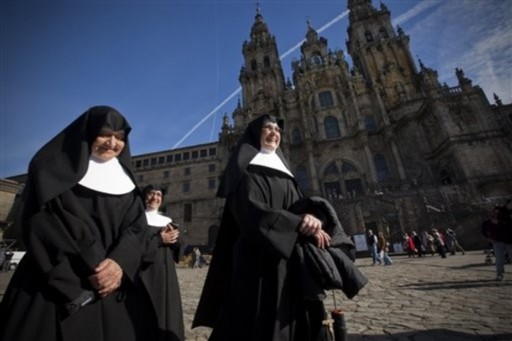
Nuns walk through the Obradoiro square in front of the Cathedral of Santiago de Compostela, background, Spain, on Friday, Nov. 5, 2010. Pope Benedict XVI will visit the pilgrimage city of Santiago de Compostela on Nov. 6 to celebrate his Holy year. (Getty Images / AP Photo/Lalo R. Villar)

November 06, 2010 VATICAN CITY (KATAKAMI / AP)  – Pope Benedict XVI begins a pilgrimage to Spain on Saturday to visit two of Christianity's most spectacular sites, fulfilling a long-held personal wish while pressing his bid to revive the faith in a once-staunchly Catholic country that is now among Europe's most liberal.

Benedict arrives first in Santiago de Compostela, Spain, a medieval and present-day pilgrimage site whose ornate cathedral is said to hold the remains of St. James the Apostle.

He wraps it up on the other side of the country in Barcelona, where he'll dedicate the famous albeit unfinished Sagrada Familia church — and face a gay "kiss-in" expected to draw thousands.

With such opposition palpable, it's no coincidence that Spain's Socialist Prime Minister Jose Luis Rodriguez Zapatero will only see Benedict as he's leaving on Sunday night. Laws under Zapatero's watch allowing gay marriage, fast-track divorce and easier abortions have deeply angered the Vatican.

In Zapatero's place, Spain's royal family will take care of the protocol meeting and greeting functions during the two-day visit.

The Rev. Federico Lombardi noted that Benedict had long hoped to make a pilgrimage to Santiago with his brother, Monsignor Georg Ratzinger, but they never got a chance and now Ratzinger is too old and frail to travel.

Millions of the faithful every year take part in the "Camino de Santiago" pilgrimage to the western Galician city — even more so in this jubilee year, which occurs every time the feast of St. James — July 25 — falls on a Sunday.

The scallop shell symbol of St. James, ubiquitous around the city, is particularly important to Benedict: it forms the central part of his papal coat of arms.

"From the beginning of my pontificate, I have tried to live my ministry as the successor of Peter with the sentiments of a pilgrim," Benedict said in a message last month to pilgrims at the Santiago sanctuary.
In Santiago, Benedict will do as the pilgrims do — embrace a statue of the apostle in the cathedral, pray before his tomb, and watch as the cathedral's enormous "botafumiero" incense burner swings pendulum-like across the length of the transept.

He'll also celebrate a Mass in the plaza outside. As many as 200,000 people are expected to travel to Santiago to see the pontiff, packing the square and cobblestone streets of the city's beautiful old quarter.
Tensions rose even before the pope arrived, as riot police swinging truncheons clashed Thursday night with anti-papal protesters in Santiago, some of whom carried red banners reading "I am not waiting for you."
In Barcelona, where Benedict arrives Saturday night, hundreds of people staged a peaceful nighttime rally Thursday against the visit, with banners decrying everything from the cost of hosting the pope to the pedophile priest scandal that has rocked the Vatican.

The centerpiece of Benedict's visit to Barcelona is the dedication Sunday of one of Spain's greatest architectural marvels, Antoni Gaudi's Sagrada Familia church.

The Vatican says the Mass in Barcelona could draw as many as 100,000 people who will witness as the church — over 100 years in construction and still unfinished — is declared a basilica.

Gaudi, one of Catalan's star modernist architects, was killed in 1926 when he was run over by a tram, leaving his life's work woefully unfinished. He is on the path to possible sainthood, though Benedict isn't expected to make any major announcements during his visit, Vatican officials say.

Thousands of gays and lesbians plan a kiss-in in the pope's presence as he leaves the grounds of the city's actual cathedral on Sunday morning, puckering up en masse to protest the conservative pontiff, whose opposition to gay marriage is well known.

The protests are clear indications of how the influence of the Catholic Church in Spain has waned in the decades since conservative dictator Francisco Franco died in 1975. After Franco's rigid social and political constraints came an explosion of hedonism and cultural vigor that has horrified the Vatican and spurred this second of three planned trips by Benedict to the country.

For many liberal Spaniards, though, the church's association with the Franco regime has been a cause for much of the alienation.

(MS)

Clinton heads to Melbourne


First official visit: Hillary Clinton (AFP: Saul Loeb, file photo)

November 06, 2010 (KATAKAMI / ABC.NET.AU) --- Hillary Clinton will arrive in Australia later today on her first official visit since becoming the United States secretary of state.

Ms Clinton is on a two-week tour through the Asia-Pacific region and today will fly into Melbourne.
Her visit is part of the annual talks between the Australian foreign and defence ministers and the US secretaries of state and defence.

Those talks will take place on Monday and will focus on regional and global security issues, including the war in Afghanistan.

Tomorrow, Ms Clinton will meet Prime Minister Julia Gillard.

The pair met briefly at last month's East Asia Summit in Vietnam.

Ms Clinton was due to visit Australia in January this year, but postponed her trip because of the devastating earthquakes in Haiti.

Meanwhile, Ms Clinton has ruled out running for president in 2012 or 2016, saying the United States should be ready for a woman president but it would not be her.

In interviews in New Zealand, the failed 2008 presidential candidate made clear she had no plans to run again despite talk - fueled partly by her fellow Democrats' losses in Tuesday's US mid-term elections - she might embark on a new race.

Asked by TV3 New Zealand whether she ruled out standing for the top US office through 2016, Ms Clinton, according to a US reporter, replied: "Oh yes, yes. I'm very pleased to be doing what I'm doing as secretary of state."

(MS)
Speaker Nancy Pelosi running for House minority leader


U.S. House Speaker Nancy Pelosi (D-CA) hosts a Democratic congressional election night results watch rally in Washington, November 2, 2010. (Getty Images / REUTERS/Jonathan Ernst )

November 05, 2010 (KATAKAMI / Reuters) - Speaker of the House of Representatives Nancy Pelosi ended speculation that she may quietly step aside after her Democrats lost midterm elections, announcing on Friday she will run for minority leader in the new Republican-led chamber next year.

Pelosi made the announcement via her Twitter account, saying, "Driven by the urgency of creating jobs" and protecting healthcare, Wall Street reform and Social Security and Medicare, "I am running" for Democratic leader.

In the wake of Republicans winning control of the House from Democrats in the midterm congressional elections on Tuesday, Pelosi may face a challenger -- though none have yet surfaced.

House Democrats, particularly Pelosi's fellow liberals, are expected to rally behind their embattled 70-year-old leader, who in 2007 became the chamber's first woman speaker and is a close ally of President Barack Obama.

House Democratic Leader Steny Hoyer, the party's No. 2 in the chamber, had already said he would not challenge Pelosi if she decided to seek the post.

Republicans won the House in a landslide, promising to slam the brakes on Obama's agenda that Pelosi pushed through the House the past two years, including an overhaul of the U.S. healthcare system and a crackdown on Wall Street.

The White House declined comment on the leadership process. "As the president has said before, he appreciates the work of the speaker and the entire House Democratic leadership team who have been great partners in moving the country forward," a spokesman said.

There had been widespread speculation that Pelosi, who Republicans made their top election-year target, might step away from House Democratic leadership or even resign from Congress.

While polls show less than one in three Americans approve of the powerful yet often polarizing Pelosi, she won re-election on Tuesday to a 13th term from her liberal California district with 80 percent of the vote.
Pelosi, in a letter to fellow House Democrats, wrote that she intends to stay and fight to protect their legislative achievements.

"Our work is far from finished. As a result of Tuesday's election, the role of Democrats in the 112th Congress will change, but our commitment to serving the American people will not," Pelosi wrote.

"We have no intention of allowing our great achievements to be rolled back. It is my hope that we can work in a bipartisan way to create jobs and strengthen the middle class," Pelosi added.

"MOST EFFECTIVE MEMBER"

Pelosi declared her candidacy after conferring with fellow House Democrats. Several members said they would not support her, but many urged her to run.

"The fact is, Nancy Pelosi is the single most effective member of Congress, period," said Democratic Representative George Miller, a longtime ally.

Larry Sabato, a political science professor at the University of Virginia, noted that Pelosi has been described as the most powerful House speaker since Sam Rayburn, the tough Texan who presided over the chamber more than a half-century ago.

"Now she wants to imitate Rayburn -- stay as minority leader after losing" the speakership, Sabato said.
Representative John Yarmuth, a Kentucky Democrat, made an about-face and backed Pelosi as minority leader, a day after saying, "I don't think she's the right leader to take us forward."

Yarmuth said on Thursday he would prefer Hoyer as minority leader, but on Friday said he would vote for Pelosi, citing her ability to "build consensus" in a diverse Democratic caucus and advance policies that "improve the lives of all Americans."

But Representative Dan Boren, a conservative Oklahoma Democrat, remained opposed to Pelosi. He told Fox News that he would support someone more conservative. "People are so mad about the extremists in both parties," Boren said.

While it was unclear who, if anyone, may challenge Pelosi, Representative Heath Shuler, a conservative North Carolina Democrat, said during the campaign that he might try.

Hoyer, a moderate, had been seen as the likely new House minority leader if Pelosi decided not to seek the post.

Within minutes after Pelosi announced she wanted the job, Hoyer's office said he may run for the No. 2 Democratic position in the new Republican House, minority whip.

But Hoyer would face a fight. The current House Democratic Whip, James Clyburn, announced on Friday that he intends to run again for the job.

Clyburn offered Democrats hope, noting that in both 1946 and 1952, they lost control of the House, but quickly regrouped and won back the chamber two years later.

Representative Chris Van Hollen is the only member of House Democratic leadership to say he will step down. He plans to surrender his post as head of the House Democratic campaign committee as soon as any remaining undecided races are settled.

(MS)

Indonesian Military (TNI) to build more field hospitals, kitchens to serve evacuees from Mt. Merapi eruptions


Indonesian soldiers (Kopassus) search for victims of Mount Merapi eruption at a village that was hit by pyroclastic flow in Argomulyo, Yogyakarta, Indonesia, Friday, Nov. 5, 2010. A deadly surge of blistering gases cascaded down the slopes of Indonesia's most volatile volcano Friday, torching houses in one mountainside village and triggering a chaotic midnight evacuation. (Getty Images / AP Photo/Trisnadi)

November 06, 2010 (KATAKAMI / THE JAKARTA POST) --- The Indonesian Military (TNI) will set up more field hospitals and public kitchens in several places to serve evacuees from Mt. Merapi eruptions, the National Disaster Mitigation Agency (BNPB) said Friday.

BNPB director Wisnu Wijaya told Antara news agency the TNI would deploy a brigade of personnel to support the disaster mitigation efforts, in line with President Susilo Bambang Yudhoyono's order.

The brigade consists of medical, engineering, marine and transport battalions.

Wisnu said the military brigade would set up field hospitals, activate all hospitals in the region and open public kitchens.

The military would also mobilize transport means to help evacuation of people.

The Air Force meanwhile has also prepared six Hercules C-130 and three C-212 Cassa planes at its Abdurahman Saleh airbase in Malang, East Java, in case a mass evacuation of refugees takes place.

The airbase's commander, Air Commodore Agus Dwi Putranto, told reporters the armada of planes had just arrived from a mission to flood-stricken Wasior in West Papua.

(*)

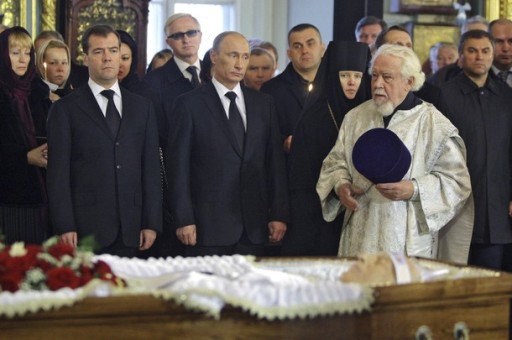
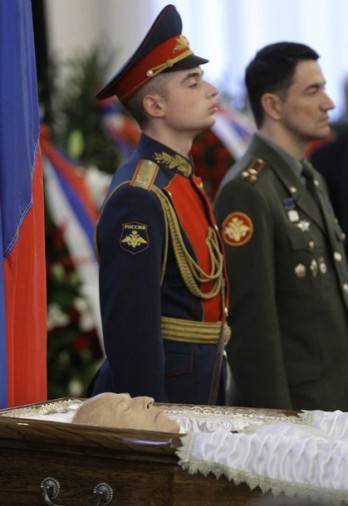
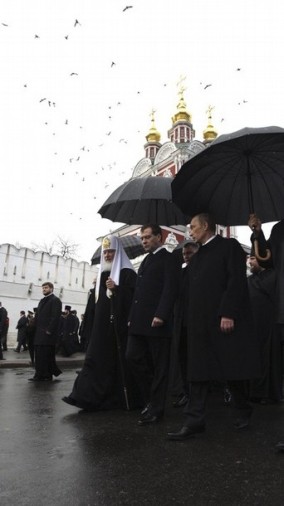
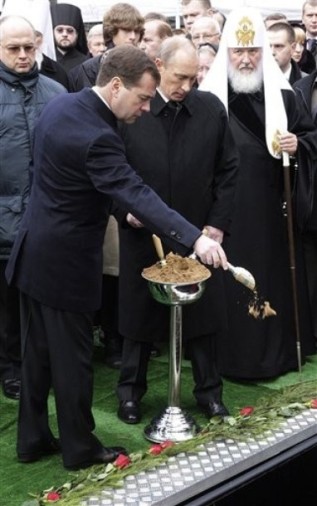
Photostream : Former Russian Prime Minister Viktor Chernomyrdin buried in Moscow's Novodevichy Cemetery


Russia's President Dmitry Medvedev (L) and Prime Minister Vladimir Putin (C) pay their respects to former Prime Minister Viktor Chernomyrdin during a memorial service at the Novodevichy monastery in Moscow, November 5, 2010. The longest serving Prime Minister in post-Soviet Russia, Chernomyrdin died on Wednesday at the age of 72. (Getty Images / REUTERS/RIA Novosti/Kremlin/Alexsey Druginyn )

Honour guards stand at attention next to the coffin of former Prime Minister Viktor Chernomyrdin during a commemoration ceremony in Moscow, November 5, 2010. The longest serving Prime Minister in post-Soviet Russia, Chernomyrdin died on Wednesday at the age of 72. (Getty Images / REUTERS/Pool/Mikhail Metzel )

Russia's President Dmitry Medvedev (C), Prime Minister Vladimir Putin (R) and Orthodox Patriarch of Moscow and All Russia Kirill walk behind the coffin of former Prime Minister Viktor Chernomyrdin during his funeral at Novodevichy monastery in Moscow, November 5, 2010. The longest serving Prime Minister in post-Soviet Russia, Chernomyrdin died on Wednesday at the age of 72. (Getty Images / REUTERS / RIA Novosti / Pool/Alexsey Druginyn )

Russia's President Dmitry Medvedev (R) walks behind the coffin of former Prime Minister Viktor Chernomyrdin during his funeral at Novodevichy monastery in Moscow, November 5, 2010. The longest serving Prime Minister in post-Soviet Russia, Chernomyrdin, died on Wednesday at the age of 72. (Getty Images /REUTERS/RIA Novosti/Kremlin/Mikhail Klimentyev )

From left, Russian President Dmitry Medvedev, Prime Minister Vladimir Putin and Russian Orthodox Patriarch Kirill are seen during the funeral of former Russian Prime Minister Viktor Chernomyrdin at Novodevichy Cemetery in Moscow, Russia, Friday, Nov. 5, 2010. Viktor Chernomyrdin, who served as Russia's prime minister in the turbulent 1990s as the country was throwing off communism and developing as a market economy, died Wednesday. (Getty Images / AP Photo/RIA Novosti, Mikhail Klimentyev, Presidential Press Servicel)

11/05/2010

President Yudhoyono back to Yogyakarta to closely monitor Merapi


Soldiers carry a body from Argomulyo village in Indonesia's Sleman district of Central Java province November 5, 2010. Indonesia's Mount Merapi volcano erupted with renewed ferocity on Friday, killing another 54 people and blanketing the surrounding area with ash. Ten days of eruptions have now killed nearly 100 people and forced the evacuation of more than 75,000. REUTERS/Stringer

November 05, 2010 (KATAKAMI / THE JAKARTA POST) --- President Susilo Bambang Yudhoyono announces he will closely monitor the situation of Mount Merapi from Yogyakarta as the volcano's three major eruptions early on Friday have brought the death toll to some 100.

Yudhoyono said after a coordination meeting with some Cabinet ministers, the Indonesian Military (TNI) chief and the National Police chief at the Presidential Office in Jakarta he would come back to Yogyakarta on Friday evening and may stay in the presidential palace there to lead the disaster mitigation efforts. The president visited Yogyakarta and neighboring Magelang only on Tuesday and Wednesday to meet with people seeking refuge from the disaster.

Presidential spokesman Julian Aldrin Pasha said the president might move to the Military Academy in Magelang if Yogyakarta was uninhabitable, and that the length of his stay would depend on the development of the situation.

Yudhoyono also announced several instructions in a press conference after the meeting, including that all emergency activities would be under the sole command of National Disaster Mitigation Agency (BNPB) head Syamsul Maarif, whose status has been lifted to a ministerial level.

"Although the Yogyakarta and Central Java administrations still function, seeing the scale of the disaster it is better than BNPB head takes the command with assistance from Yogyakarta and Central Java governors, Diponegoro Military Command chief, and Central Java and Yogyakarta police chiefs," Yudhoyono said.

He added that he had instructed Coordinating Minister for People's Welfare Agung Laksono to organize humanitarian relief for Merapi refugees, and the TNI to dispatch a brigade to help build temporary hospitals and emergency kitchens, as well as evacuate people.

The president also announced the government would allocate budget to buy cattle belonging to the locals at agreeable prices, saying it was expected to lure them not to return to their homes to take care of the animals after evacuation order was issued. He assigned Agung and the Yogyakarta and Central Java governors to deal with the matter.

Concluding the press conference, Yudhoyono asked journalists and the nation to pray for the safety of people around the volcano and an end of the calamity. (*)

Death toll from Indonesian volcano nears 100


A rescuer searches for victims of Mount Merapi eruption in Argomulyo, Yogyakarta, Indonesia, Nov. 5, 2010. (Getty Images / AP Photo/Gembong Nusantara)

November 05, 2010 (KATAKAMI) --- The death toll from Indonesia's volcano has climbed to nearly 100 in more than a week after a blistering gas cloud ripped through a mountainside village.

Hospital spokesman Heru Nugroho said 54 bodies were brought in after the inferno. More than 66 others were injured, many of them critically with burns.

Men with ash-covered faces streamed down Mount Merapi on motorcycles followed by truckloads of women and crying children, following the massive eruption just before midnight Friday.

Soldiers helped clear the bodies from the hard-hit village of Bronggang, located 9 miles (15 kilometers) from the crater, and up until Friday considered within the "safe zone."

The toll since Oct. 26 - including 44 killed before Friday's massive gas burst - stood at 98.


(MS)

Photostream : Death toll from Indonesia’s Mount Merapi volcano nears 100


The bodies of victims of Mount Merapi eruption are placed at a hospital in Yogyakarta, Indonesia, Friday Nov. 5, 2010. A deadly surge of blistering gases cascaded down the slopes of Indonesia's most volatile volcano, torching houses in one mountainside village. (Getty Images / AP Photo/Achmad Ibrahim)

Rescuers carry the body of a victim of Mount Merapi eruption in Argomulyo, Yogyakarta, Indonesia, Nov. 5, 2010. A deadly surge of blistering gases cascaded down the slopes of Indonesia's most volatile volcano, torching houses in one mountainside village. (Getty Images / AP Photo/Gembong Nusantara)

Rescuers carry the body of a victim of Mount Merapi eruption in Argomulyo, Yogyakarta, Indonesia, Friday, Nov. 5, 2010. A deadly surge of blistering gases cascaded down the slopes of Indonesia's most volatile volcano, torching houses in one mountainside village. (Getty Images / AP Photo/Trisnadi)

Indonesian rescuers carry the body of a victim of Mount Merapi, at hospital in Yogyakarta, Indonesia, Friday Nov. 5, 2010. A deadly surge of blistering gases cascaded down the slopes of Indonesia's most volatile volcano, torching houses in one mountainside village. (Getty Images / AP Photo/Achmad Ibrahim)

The body of a victim of Mount Merapi eruption lies on a ground covered with volcanic ash in Argomulyo, Yogyakarta, Indonesia, Friday, Nov. 5, 2010. A deadly surge of blistering gases cascaded down the slopes of Indonesia's most volatile volcano Friday, torching houses in one mountainside village and triggering a chaotic midnight evacuation. (Getty Images /AP Photo/Trisnadi)

The body of a victim of Mount Merapi eruption lies on a road covered with volcanic ash as a rescuer walks by in Argomulyo, Yogyakarta, Indonesia, Friday, Nov. 5, 2010. (Getty Images / AP Photo/Trisnadi)

The hand of a victim of Mount Merapi eruption is seen covered in volcanic ash in Argomulyo, Yogyakarta, Indonesia, Friday, Nov. 5, 2010. A deadly surge of blistering gases cascaded down the slopes of Indonesia's most volatile volcano Friday, torching houses in one mountainside village and triggering a chaotic midnight evacuation. (AP Photo/Trisnadi)

The hand of a Mount Merapi eruption victim is seen at a hospital in Yogyakarta, Indonesia, Friday Nov. 5, 2010. A deadly surge of blistering gases cascaded down the slopes of Indonesia's most volatile volcano, torching houses in one mountainside village. (Getty Images / AP Photo/Achmad Ibrahim)

Dead cow killed in an eruption of Mount Merapi lies covered in volcanic ash as rescuers search for victims in Argomulyo, Yogyakarta, Indonesia, Nov. 5, 2010. A deadly surge of blistering gases cascaded down the slopes of Indonesia's most volatile volcano Friday, torching houses in one mountainside village and triggering a chaotic midnight evacuation. (Getty Images / AP Photo/Gembong Nusantara)

Indonesian soldiers (TNI) search for victims of Mount Merapi eruption in Argomulyo, Yogyakarta, Indonesia, Nov. 5, 2010. A deadly surge of blistering gases cascaded down the slopes of Indonesia's most volatile volcano, torching houses in one mountainside village. (Getty Images / AP Photo/Gembong Nusantara)

Villagers take shelter after they fled their homes following another eruption of Mount Merapi in Klaten, Indonesia, Friday, Nov. 5, 2010. A deadly surge of blistering gases cascaded down the slopes of Indonesia's most volatile volcano Friday, torching houses in one mountainside village and triggering a chaotic midnight evacuation. (AP Photo/Achmad Ibrahim)

Indonesian soldiers search for victims of Mount Merapi eruption at a village that was hit by pyroclastic flow in Argomulyo, Yogyakarta, Indonesia, Friday, Nov. 5, 2010. A deadly surge of blistering gases cascaded down the slopes of Indonesia's most volatile volcano Friday, torching houses in one mountainside village and triggering a chaotic midnight evacuation. (Getty Images / AP Photo/Trisnadi)

An ash covered victim of Mount Merapi eruption arrives at a hospital in Yogyakarta on November 5, 2010. At least 49 people were killed and dozens injured Friday when Indonesia's Mount Merapi volcano erupted again, burning villages as far as 18 kilometres (11 miles) away, officials said. The latest deaths bring the total toll to more than 90 since the country's most active volcano started erupting on October 26. (Photo by SONNY TUMBELAKA/AFP/Getty Images)

Death toll from Indonesia's Mount Merapi climbs to 79


Rescuers carry the body of a victim of Mount Merapi eruption in Argomulyo, Yogyakarta, Indonesia, Friday, Nov. 5, 2010. A deadly surge of blistering gases cascaded down the slopes of Indonesia's most volatile volcano, torching houses in one mountainside village. (Getty Images / AP Photo/Trisnadi)

November 05, 2010 (KATAKAMI / THE JAKARTA POST / AP) --- A deadly surge of blistering gases cascaded down the slopes of Indonesia's most volatile volcano, torching houses in one mountainside village and nearly doubling the number of people killed in just over a week to 79.

Thirty-five bodies were brought to a morgue at a nearby hospital, which was struggling to cope with victims. More than 65 people were injured, many of them critically.

Mount Merapi, which means "Fire Mountain," has erupted many times in the last century, often with deadly results.

Though more than 75,000 people living along its fertile slopes have been evacuated to crowded emergency shelters, many by force, others are reluctant to leave their precious livestock. Some return to their villages during lulls in activity to bring fresh grass.

It was not immediately clear why Bronggang, a village nine miles (15 kilometers) from the crater, had not been evacuated when the searing ash, gases and rock fragments hit just before midnight.

"We're totally overwhelmed here!" said Heru Nogroho, a spokesman at the Sardjito hospital, as soldiers continued to bring in victims, many with severe burns.

Despite earlier predictions by scientists that dozens of big explosions that followed Merapi's initial Oct. 26 blast would ease pressure building up behind a magma dome, eruptions appeared to be intensifying.

"I've never seen it act like this," said Surono, a state expert on volcanos, who has observed Merapi for more than 15 years. "We don't know what to expect."

Towering clouds of ash shot from the crater with a thunder-like roar on Thursday morning, sending soot 20,000 feet (6,000 meters) into the air and dusting towns up to 150 miles (250 kilometers) away.

Just before midnight, Merapi erupted again, sending pyroclastic flows down the mountain.

Such clouds can reach temperatures of up to 1,400 degree Fahrenheit (750 degree Celsius), while racing down the slopes at speeds of up to 60 miles per hour (100 kilometers per hour).

Waluyo Raharjo, a search and rescue official, was on the scene as bodies were pulled from charred homes and loaded into vehicles, bringing them to the hospital morgue.

Activity at the mountain forced an airport in nearby Yogyakarta to close Friday.

Subandrio, a state volcanologist, meanwhile, said Mount Merapi's "danger zone" was widened to 12 miles (20 kilometers) from the crater's mouth.

It was the second time in as many days the area was expanded.

Indonesia, a vast archipelago of 235 million people, is prone to earthquakes and volcanos because it sits along the Pacific "Ring of Fire," a horseshoe-shaped string of faults that lines the Pacific Ocean.

The volcano's initial blast occurred less than 24 hours after a towering tsunami slammed into the remote Mentawai islands on the western end of the country, sweeping entire villages to sea and killing at least 428 people.

There, too, thousands of people were displaced, many living in government camps.


(MS)

Russian President thanks Japan PM for invitation to APEC summit


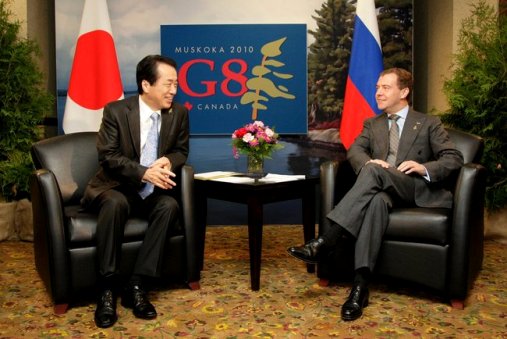
File photo : Prime Minister of Japan Naoto Kan ( left) with Russian President Dmitry Medvedev (June 26, 2010)

November 04, 2010 (KATAKAMI / KREMLIN.RU) --- President Dmitry Medvedev sent a response message to Prime Minister of Japan Naoto Kan thanking him for the invitation to take part in the 18th APEC Economic Leaders’ Meeting in Yokohama on November 13–14, 2010.
The Russian President’s message reads, in part:

“I fully share the belief in APEC’s importance in expanding multilateral political and economic cooperation in the Asia-Pacific region as part of the effort to find effective responses to modern challenges.

I intend to actively participate in discussions on the main theme of Japan’s presidency, Change and Action. I hope that the forum will prompt its participants to adopt a set of joint measures to overcome the effects of the global financial crisis and to develop an optimal model of APEC region’s development in the post-crisis period with an emphasis on economic and social security.

I am confident that the summit will make a tangible contribution to sustainable growth of the economies participating in the forum.”


(MS)

11/04/2010

Photostream : Indonesia's Mount Merapi Erupts Again


Massive molten lava and searing ash clouds shoot from the crater of Mount Merapi captured in this extended time exposure photograph taken from Klaten district in Central Java province before dawn on November 4, 2010. Thousands more people were evacuated from villages around Indonesia's Mount Merapi as the volcano erupts again, shooting ash and heat clouds high into the sky. The 2,914-metre (9,616-foot) Merapi, is a sacred landmark in Javanese culture whose name translates as "Mountain of Fire." (Photo by SONNY TUMBELAKA/AFP/Getty Images)

Molten lava flows from the crater of Mount Merapi captured in this extended time exposure photograph taken from Klaten district in Central Java province. An avalanche of heat clouds that can kill anything in their path streamed nine kilometres down the slopes of the volcano (AFP/Sonny Tumbelaka)

A view from a domestic flight from Denpasar to Yogyakarta that was subsequently diverted to Surabaya airport shows gas and ash billowing some 10 km (six miles) high from Mount Merapi on November 4. Indonesia ordered thousands more people to evacuate as the country's most active volcano erupted again, shooting gas and ash into the sky and triggering a new aircraft exclusion zone. (AFP/Clara Prima)

Mount Merapi volcano erupts for the fifth time as seen from Wukirsari village in Sleman, near the ancient city of Yogyakarta November 4, 2010. Mount Merapi has killed at least 39 people since it began erupting on October 26. Over 74 have been injured and more than 70,000 people have been evacuated, according to Indonesia's National Disaster Management Board. REUTERS/Beawiharta

A man wearing a mask sits at a temporary shelter at Bawukan village in Klaten of central Java province November 4, 2010. Indonesia's Mount Merapi blasted ash and gas into the sky on Thursday, killing six more people in the latest in a series of eruptions over the past nine days that claimed 44 lives and forced more than 75,000 to flee their homes. REUTERS/Andry Prasetyo

A man rides his motorcycle during ash rain in the city of Magelang as Mount Merapi volcano erupts November 4, 2010. Mount Merapi has killed at least 39 people since it began erupting on October 26. Over 74 have been injured and more than 70,000 people have been evacuated, according to Indonesia's National Disaster Management Board on Wednesday (REUTERS/Beawiharta)

Villagers ride on a truck as they leave their homes on a street covered by volcanic ash from the eruption of Mount Merapi in Muntilan, Indonesia, Thursday, Nov. 4, 2010. Indonesia's deadly volcano sent a burst of searing gas high into the air Thursday, hours after its most explosive eruption in a deadly week triggered an exodus from villages and emergency shelters along its rumbling slopes. (AP Photo/Trisnadi)

A family rides a motorcycle as they move to a temporary shelter which is further away from Mount Merapi volcano at Harjobinangun village in Sleman, near the ancient city of Yogyakarta, in the early morning of November 4, 2010. Mount Merapi has killed at least 39 people since it began erupting on October 26. Over 74 have been injured and more than 70,000 people have been evacuated, according to Indonesia's National Disaster Management Board on Wednesday. (Getty Images / REUTERS/Dwi Oblo )

Qantas suspends A380 flight


Qantas Chief Executive Officer Alan Joyce gives a news conference at the Qantas headquarters in Sydney November 4, 2010. Australian airline Qantas Airways grounded its entire fleet of A380 aircraft on Thursday after an engine failure forced one its flights to make an emergency landing in Singapore. (Getty Images / REUTERS/Daniel Munoz )

November 04, 2010 (KATAKAMI / THE JAKARTA POST) --- Qantas CEO Alan Joyce says the airline is suspending all flights of its six Airbus A380 jetliners after a mid-air engine problem on a flight from Singapore.

Joyce told a news conference in Sydney on Thursday the suspension would remain in place until Qantas was satisfied that it was safe for its A380s to fly.

Joyce said "we will suspend those A380 services until we are completely confident that Qantas safety requirements have been met."

(*)

Photostream : Qantas jumbo makes emergency landing in Singapore, after one of its four engines failed over western Indonesia

Indonesian police officers inspect parts of a Qantas jetliner that were found in the area, at the local police headquarters in Batam, Indonesia, Thursday, Nov. 4, 2010. The jetliner made an emergency landing Thursday in Singapore with 459 people aboard, after one of its four engines shut down over western Indonesia and following witness reports of a blast that sent debris hurtling to the ground. (Getty Images / AP Photo/Tundra Laksamana)
Indonesian police examine fallen debris from a Qantas jet collected from several areas on Batam island, an Indonesian territory near Singapore November 4, 2010. None of the passengers or crew aboard a Qantas jet was injured when the plane was forced to shut down one engine and make an emergency landing in Singapore, Australia's foreign ministry said on Thursday. (Getty Images / REUTERS/Stringer )
Indonesian police officers carry a part of a Qantas jetliner that was found in the area, at the local police headquarters in Batam, Indonesia, Thursday, Nov. 4, 2010. A Qantas jetliner made an emergency landing Thursday in Singapore with 459 people aboard, after one of its four engines shut down over western Indonesia and following witness reports of a blast that sent debris hurtling to the ground. (Getty Images / AP Photo/Tundra Laksamana)
In this image taken from TV, people look at debris found in Batam, Indonesia Thursday, Nov. 4, 2010. A Qantas jetliner made an emergency landing Thursday in Singapore with 459 people aboard, after one of its four engines shut down over western Indonesia and following witness reports of a blast that sent debris hurtling to the ground. The airliner denied there had been any explosion, and said the plane landed safely with no injuries. (Getty Images / AP Photo/RTCI via APTN)
Airport policemen ask the media to leave the restricted area while passengers unboard a troubled Qantas Airbus A380 plane after an emergency landing at the Changi International airport in Singapore on November 4, 2010. The Qantas A380 made a dramatic emergency landing in Singapore, trailing smoke from a damaged engine, in the first mid-air emergency involving the Airbus superjumbo. The double-decker plane, which had taken off from Singapore bound for Sydney carrying 433 passengers and 26 crew, dumped fuel over Indonesia before returning to the city-state's Changi Airport. (Photo by ROSLAN RAHMAN/AFP/Getty Images)
A troubled Qantas Airbus A380 plane seen after an emergency landing at the Changi International airport in Singapore on November 4, 2010. The troubled Qantas Airbus A380 plane made an emergency landing in Singapore with smoke coming out of its underside and was quickly surrounded by six fire engines (Photo by ROSLAN RAHMAN/AFP/Getty Images)

President Obama says he feels bad about midterms, takes blame for Republican rout of Democrats


U.S. President Barack Obama speaks during a news conference in the East Room of the White House in Washington, November 3, 2010. (Getty Images / REUTERS/Kevin Lamarque )

November 03, 2010 (KATAKAMI / NYDailyNews.com) --- President Obama acknowledged Wednesday that he took a "shellacking" at the hands of the Republicans but said he stands by his policies.

With the stinging rebuke, Obama acknowledged he is ready to work with GOP leaders to solve the nation's ills.
"This is something, I think, every President needs to go through," a somber Obama said a day after his Democrats were trounced at the ballot box and the Republicans took control of the House.

Obama said he understands the anguish of average Americans during these tough economic times - and conceded he hasn't done enough to let the people know he feels their pain.

"In the rush of activity we lose track of the ways that we connect with the folks that got us here in first place," he said. "Those letters I read every night, some of them break my heart. But nobody is filming me reading those letters."

Obama said he takes some comfort in the fact that "a couple great communicators, Ronald Reagan and Bill Clinton, were standing at the podium two years into it (their first terms) getting these kind of questions."
It was an out-of-character admission from the normally cool and composed Obama whose critics have accused him of leading the nation more like a professor than a President.

Four years ago, President Bush admitted to receiving a "thumping" from the Democrats in the congressional elections. But he still managed to muster a grin.

There was no smile on Obama's face at the White House when he emerged for his first post-election debacle press conference.

Obama quickly made news by signalling a willingness to possibly compromise on the Bush tax cuts. He had said in the past he wants to extend them to everybody except people making over $250,000-a-year.

"My goal is to make sure we don't have a huge spike in taxes for middle class families," he said. "It would be bad for our economy."

Obama also said he's willing to discuss ways of improving his signature health care reform, but won't scrap it altogether as many Republicans have demanded.

The President also reiterated his desire to scrap "Don't Ask, Don't Tell," another move opposed by many in the GOP.

When asked how if felt to get thrashed at the polls, Obama drew some chuckles by answering, "It feels bad."

"I take responsibility for it," he said.

Obama addressed the press after jubilant Republicans claimed a mandate to roll back much of what the President and the Democrats accomplished in the last two years.

"It's pretty clear the American people want a smaller, less costly, more accountable government here in Washington," said Ohio Rep. John Boehner, who is expected to be Speaker of the House when the new Congress begins work in January.

Obama said he's open to ideas from the GOP but "no one party will be able to dictate where we will go from here, we must find common ground."

The President said he got the message loud and clear that the "number one concern is economy" and that Americans are "deeply frustrated" by the high unemployment.

"They want jobs to come back faster, they want paychecks to go further," he said.

Obama insisted the economy has begun to recover since he took office but "people aren't feeling that progress."

"They don't see it," he said. "We have not made as much progress as we need to make."


(MS)

PM Benjamin Netanyahu: Palestinians not ready for peace


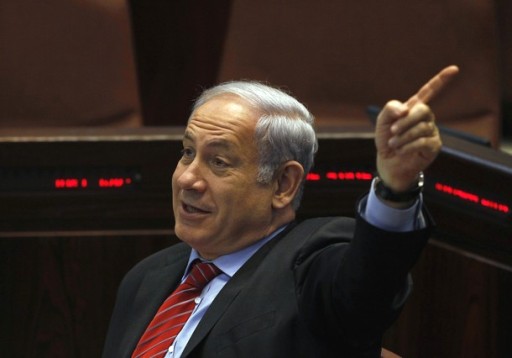
Israel's Prime Minister Benjamin Netanyahu attends a session of the Knesset, the Israeli parliament, in Jerusalem November 3, 2010. Netanyahu said on Wednesday he would meet Secretary of State Hillary Clinton during a U.S. visit next week in addition to previously announced talks with Vice President Joe Biden. (Getty Images / REUTERS/Ammar Awad )

November 03, 2010 (KATAKAMI / YNET) --- During debate titled 'The world against Israel – how the Netanyahu administration isolated Israel in the international arena,' PM says, 'Rejecting Israel's right to exist doesn't advance reconciliation.' MK Bar-On: Bold decision required.

Prime Minister Benjamin Netanyahu attended a special Knesset debate titled "The world against Israel – how the Netanyahu administration isolated the State of Israel in the international arena." A request to hold a discussion on the matter was signed by 40 Knesset members, including Amir Peretz, Eitan Cabel and Daniel Ben-Simon.

First to speak was MK Ronnie Bar-On (Kadima), who slammed Netanyahu. "Before you go off to a visit in the US you should sit down and read Thomas Friedman, the most prominent US commentator. 

Maybe this time the sound of danger suggested in his articles will sound clearer. In the first round he called our leadership 'drunk drivers.' In the second round, he claimed the cabinet was inhabited by lunatics. Friedman's words point to bad times of changes in Israel's relations with the US and it's not because of any particular president."

Bar-On repeated President Shimon Peres' statements calling for an immediate political decision. "Do you need a clearer warning sign? You know, it's never too late to fix things. Make a bold, uncompromising decision and go for it. We'll be there for you and for ourselves."

MK Yohanan Plesner (Kadima) said, "You've been running the country for a year and eight months, what decision have you made except create one committee after the other. Shunning responsibility is not leadership; it's a weak, indulgent and irresponsible government."

Freeze on hold

Addressing the stalled peace talks with the Palestinians, Netanyahu said, "Rejecting Israel's right to exist certainly doesn't advance reconciliation between the nations and our desire to bring about a peace agreement. The Palestinians made an official commitment in this regard – as part of the Wye agreement and other agreements. I promise to discuss this commitment during the process, but for now I want the process to move forward without preconditions.

"If (the process) fails, it will be because the Palestinian Authority is trying to bypass the negotiations and move the process to the international track," he said.

As for the public uproar surrounding the yeshiva student bill, Netanyahu said, "We are doing exactly what has been done for the past 30 years. The haredim are part of our nation, and should be treated as such. This public should be encouraged to work."   


Likud MK Ofir Akonis responded to the Kadima claims and said, "Your Alzheimer's is really advanced. You decided to take a cynical, political ride on the backs of Israeli students," he said. "Have you no shame – to insinuate that Israel is to blame for the Marmara flotilla?"


Akonis noted that substantial stipends were given to haredim during the Kadima administration and presented a newspaper with the title: "Livni to Shas: Receive NIS 1 billion (about $280 million)." He was then escorted from the podium by security guards for violating Knesset protocol. Later, Kadima's Yoel Hasson was also removed from the hall after verbally attacking MK David Rotem (Yisrael Beiteinu).

MK Nissim Zeev (Shas) addressed the Labor MKs and said: "You can’t crush the coalition from the inside because of problems with your party chairman. I have unresolved business with the defense minister. I think he made a fool of himself, with the Galant document, with his foreign worker…they caught the most dangerous terrorist in the world – Virginia." 

Earlier this week, Netanyahu addressed the peace process during a Likud faction hearing at the Knesset. When asked about the possibility of the resumption of settlement construction freeze he replied there was no concrete US proposal and that the matter was on hold.

(MS)

PM Netanyahu says he will meet Clinton during U.S. visit


File photo : Israeli Prime Minister Benjamin Netanyahu (L) meets with U.S. Secretary of State Hillary Clinton September 15, 2010 in Jerusalem, Israel. Israeli and Palestinian leaders are deadlocked in peace negotiations over Israeli settlement building. (Photo by Amos Ben Gershom / GPO via Getty Images)

November 03, 2010 (KATAKAMI / HAARETZ) --- PM will arrive in New Orleans on Sunday to address a conference of the U.S. Jewish community, where Joe Biden will also speak. 

Prime Minister Benjamin Netanyahu said on Wednesday he would meet Secretary of State Hillary Clinton during a U.S. visit next week in addition to previously announced talks with Vice President Joe Biden. 

In a speech to parliament, Netanyahu again voiced strong criticism of the Palestinian Authority, which has suspended peace talks over his refusal to resume a partial freeze of construction in Jewish settlements in the West Bank. 

"The truth is, there is great readiness in Israel for a real peace process," he said. "The truth is, we have not found a corresponding readiness within the Palestinian Authority." 

Netanyahu has resisted U.S., Palestinian and international calls to impose a new building moratorium in settlements after a 10-month freeze expired in late September, some three weeks after the U.S.-brokered negotiations began. 

Palestinian officials have accused Netanyahu of destroying prospects for peace by allowing settlement building to continue on land that Palestinians want for a future state. 

Netanyahu arrives in New Orleans on Sunday to speak at a conference of U.S. Jewish leaders that Biden also will address. President Barack Obama will be visiting Asia during Netanyahu's U.S. trip, which also includes a four-day stay in New York. 

"I will, of course, meet with the senior leaders of the United States, with Vice President Biden and subsequently with Hillary Clinton," Netanyahu told parliament. 

He gave no date or venue for the meeting with Clinton, but Israeli officials said it was likely to take place in New York. 

"I greatly appreciate the efforts of the Obama administration -- the president and his people -- to find a way to advance the peace process," Netanyahu said in his speech, giving no sign of bending in the settlement impasse.

(MS)

Meeting of Russian President Dmitry Medvedev with NATO Secretary General Anders Fogh Rasmussen


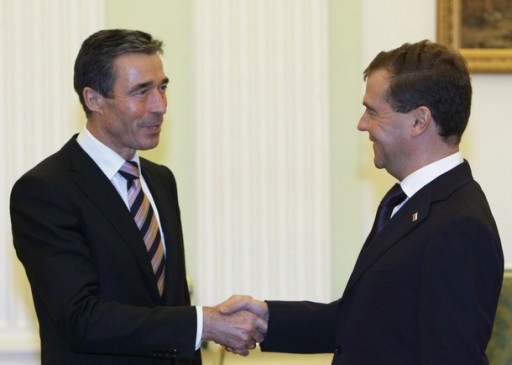
Russian President Dmitry Medvedev (R) welcomes North Atlantic Treaty Organization (NATO) Secretary-General Anders Fogh Rasmussen during their meeting in Moscow on November 3, 2010. Rasmussen said on November 3 that the alliance and Russia must bury the ghosts of the past at an upcoming summit, as he sought to persuade Moscow to join a missile defense system.  (Photo by VLADIMIR RODIONOV/AFP/Getty Images)

November 03, 2010 (KATAKAMI / KREMLIN.RU) --- Dmitry Medvedev and Anders Fogh Rasmussen discussed the current state and perspectives of Russia-NATO relations.
The President noted during the meeting that relations between Russia and NATO have gained in substance and become more productive of late, which creates opportunities for building a more solid security system in Europe and the world.

Russia’s delegation at the meeting included Foreign Minister Sergei Lavrov, Defence Minister Anatoly Serdyukov, and Russia’s Permanent Representative to NATO Dmitry Rogozin.

* * *


PRESIDENT OF RUSSIA DMITRY MEDVEDEV: Mr Secretary General, it is a pleasure to see you and wish you welcome.

I want to start by saying that relations between Russia and NATO have gained in substance and become more productive of late. We welcome this, as it creates opportunities to work harder on building up our cooperation and developing a more solid security system in Europe and the world.

We will discuss the current situation today, but I hope that later, at the summit in Lisbon, we will have the chance to talk about key cooperation areas between Russia and NATO. You know that I have decided to attend this summit, and I think it will be a useful event.

Once more, I wish you welcome to the Kremlin.

NATO SECRETARY GENERAL ANDERS FOGH RASMUSSEN:
Thank you very much, Mr President. I’m really happy to be in Moscow once again. I’m pleased that you accepted my invitation to attend the NATO-Russia Council meeting in Lisbon on the 20th of November. Now I look very much forward to a productive meeting and I’m here to prepare that meeting jointly, to make sure that it will be a productive meeting, that we will see concrete results from that meeting.
I share your view that we have seen substantial progress in our relationship during recent months. And I would very much like to develop our cooperation further. I think that summit in Lisbon will represent a fresh start for our relationship, a modernization of our relationship. And I think there is scope for further development of practical cooperation in the coming years.

November 3, 2010, 17:00The Kremlin, Moscow

Medvedev, Qatari emir discuss economic, regional cooperation


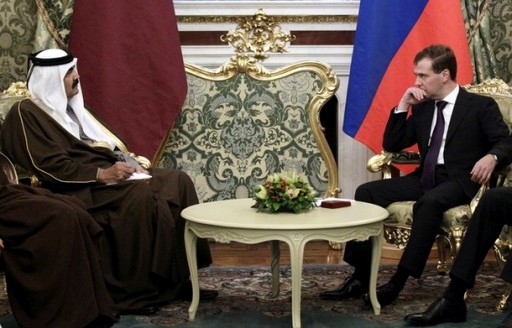
Russian President Dmitry Medvedev (R) meets with Qatar's Emir Sheikh Hamad bin Khalifa al Thani in Moscow's Kremlin, November 3, 2010. (Getty Images / REUTERS / Ivan Sekretarev/Pool )

MOSCOW, November 3 (KATAKAMI / Itar-Tass) - Russian President Dmitry Medvedev has met with Qatar’s Emir Sheikh Hamad bin Khalifa al Thani for talks on economic cooperation and regional interaction.

“Russian-Qatari relations develop successfully. Recently they have become more dynamic and mutually advantageous,” Medvedev said on Wednesday.

The Russian president proposed to discuss “economic relations between our countries and regional interaction”. Medvedev also said the Qatari emir “had interesting meetings in Russia”. “I’m sure that your stay in Russia will be intensive and fruitful,” he added.

Al Thani stressed that Qatar “seeks to develop economic cooperation with Russia”. The Qatari emir said he “had interesting meetings with Russian Prime Minister Vladimir Putin and Gazprom CEO Alexei Miller. All meetings were positive. We also discussed cultural relations due to Russia’ s heritage. We also want to develop relations in this field”. “As for our international cooperation, it is developing. I believe that it is necessary to focus more attention to the Palestinian problem,” the Qatari emir stressed.

The talks are being held at the Grand Kremlin Palace. Russia’s delegation includes Foreign Minister Sergei Lavrov and presidential aide Sergei Prikhodko. The Qatari delegation involves Prime Minister and Foreign Minister Hamad bin Jasem Al Thani.

(MS)

Al Qaeda Leader Killed in Gaza


Palestinians stand around a car that exploded in Gaza City November 3, 2010. The car exploded outside a police headquarters in the city of Gaza on Wednesday, killing one Palestinian, Hamas officials and witnesses said. The Hamas Interior Ministry said the explosion was caused by an Israeli air strike but Israel Radio said it may have been the result of the premature detonation of a car bomb. (Getty Images / REUTERS/Suhaib Salem )

November 03, 2010 (KATAKAMI / IsraelNationalNews.com) --- A senior Al Qaeda leader was killed Wednesday in Gaza. A car bomb killed the terrorist and seriously injured his partner in an explosion outside the main police headquarters in Gaza City.

Local Arabs said the man killed was a senior field commander in the "Army of Islam," associated with Al Qaeda. Hamas claimed that the car was bombed in an Israeli air attack.


(MS)