10/17/2010

Ahmadinejad: Iran ready for talks, won’t yield nuclear rights


Mahmoud Ahmadinejad warned his country won't yield any international rights to peaceful nuclear energy development. (CNN)
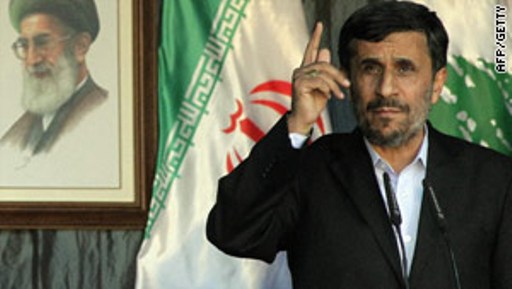
October 17, 2010 (KATAKAMI / CNN) -- Iranian President Mahmoud Ahmadinejad is taking a hard line ahead of nuclear talks scheduled for next month with world powers skeptical of his government's intentions, local media reported Sunday.

Ahmadinejad said that Iran is ready to hold talks, but warned that his country won't yield any of its international rights to peaceful nuclear energy development, according to the reports.

"Holding talks with Iran is the best choice for you," Ahmadinejad was quoted by state-run Press TV as saying at a rally in Ardebil in northwestern Iran Sunday. "You have no other option. All the other ways are closed. You know the fact very well,"

The United States and other world powers fear Iran is developing a nuclear program for military purposes. Iran has denied those allegations.

"You should make it clear that what is your aim of negotiations, friendship or hostility? Do you want to follow logic or law or issue resolution and make threat?" the semi-official Iran Student's News Agency quoted Ahmadinejad as saying. He added that Western powers should also pressure Israel over its undeclared but widely-suspected nuclear capability, ISNA said.

Last month, Ahmadinejad said an Iranian representative would meet with the "P5 plus one" group. The group is made up of the five permanent members of the United Nations Security Council -- the United States, Britain, France, China and Russia -- along with Germany.

Nuclear talks between Iran and the six powers have been stalled since October 1, 2009, when the two groups last met in Geneva.

The EU has proposed the two sides meet again in mid-November back in Geneva. Manouchehr Mottaki, Iranian foreign minister, said Saturday that November 15 had been suggested for a meeting date.

It may be a sign that Tehran is feeling the bite of increased sanctions imposed in recent months to pressure a return to talks.

Iran is now subject to four sets of U.N. sanctions, while the United States and the EU have also imposed separate penalties on Iran over its refusal to stop enriching uranium.

Still, Ahmadinejad said Iran is not weakening in its resolve, "They thought they can weaken the Iranian nation through imposing sanctions and posing threats, but Iranians have showed integrity, convergence and strength," he told Press TV.

Iran's semi-official FARS news agency also released figures claiming that trade with the P5 plus one economies had actually jumped 12 percent despite new sanctions aimed at reining in Tehran's nuclear ambitions.

It claimed that during the six months since March 21, trade had climbed to $9.3 billion. China accounted for most of Tehran's trade with the group.

Imports fell sharply from the United States, but exports to America more than doubled to $77 million, leaving Iran with a small trade surplus with the world's largest economy.

Distraught relatives gather outside Chinese mine as rescuers battle deadly coal dust in bid to free 11 trapped miners

October 17, 2010. (KATAKAMI / DAILY MAIL.CO.UK) — Dozens of anxious relatives and friends of 11 miners trapped underground by an explosion in central China gathered outside the site today as rescuers battled tons of coal dust in a bid to reach them.

The number of miners confirmed dead rose by five to 26, state media said.

China’s crisis happened as the world was still celebrating Chile’s successful rescue of 33 miners trapped for more than two months.


Distraught: Relatives of the dead and trapped miners in China’s Henan province gathered outside the mine today as rescuers battled tons of coal dust in an effort to rescue them 


Deadly: China’s mines are the most dangerous in the world. 195 people died in mining accidents in Henan in August alone 
 
 
Chinese media had detailed coverage as the Chilean men emerged to cheers.

Some in China asked whether their own officials would make as much of an effort in a similar disaster and be just as open about the progress of rescue efforts.

Yesterday’s blast at the Pingyu Coal & Electric mine occurred as workers were drilling a hole to release pressure from a gas build-up to decrease the risk of explosions, the state work safety administration said.


Guarded: Two dozen police officers were stationed outside the mine’s main gate, preventing anyone from entering the site without authorisation 
 

State media said 70 rescuers had been sent to the site in Henan province after the early-morning explosion.

But hopes of rescuing the remaining trapped workers were fading as they were buried under coal and it could take three or four days to try to find them, said a report by China National Radio.

Rescuers also faced dangerous gas levels and the risk of falling rocks as they worked their way into the mine pit.

The explosion unleashed more than 2,500 tons of coal dust, an engineer for one of the mine’s parent companies, Du Bo, told the state-run Xinhua News Agency.

A rescue spokesman told Xinhua that workers had located the trapped miners, but must clear tons of coal dust from the mine shaft to reach them.


Emergency: Rescuers prepare to descend into a mine in central China after an explosion yesterday killed 26 workers and trapped a further 11 underground 
 
Today two dozen police officers were stationed outside the mine’s main gate, preventing anyone from entering the site without authorisation.

About 50 of the trapped miners’ friends and relatives quietly waited outside.

The Chinese government has shut down more than 1,600 small, illegal coal mines this year as part of an effort to improve safety standards, the state-backed People’s Daily newspaper reported on Thursday.

However, an unknown number of illegal mines still exist to profit from the fast-growing economy’s huge appetite for power.


Relief goods: Workers carry supplies into the entrance of the Pingyu No.4 Coal mine in Yuzhou, Henan province 
 
Another gas blast at the same mine two years ago killed 23 people, state media said.

It was not clear if the miners were alive or how far underground they were trapped in the mine in the city of Yuzhou, about 430 miles south of Beijing.

China Central Television’s news channel had an excited live broadcast from the mine yesterday, but it later did not mention the accident on the main TV evening news.

The gas level inside the mine was 40 per cent, far higher than the normal level of about 1 per cent, state media said.

The gas was not specified, but methane is a common cause of mine blasts and coal dust is explosive.
China celebrated its own stunning mine rescue earlier this year, when 115 miners were pulled from a flooded mine in the northern province of Shanxi after more than a week underground.


Rescuers prepare to go underground, where they are battling dangerous levels of gas and the risk of falling coal as they work to free the trapped miners 
 
The miners survived by eating sawdust, tree bark, paper and even coal. Some strapped themselves to the walls of the shafts with their belts to avoid drowning while they slept.

But it was a rare bright spot. At least 195 people were killed in mining accidents during August in Henan this year, according to the provincial coal mine safety bureau.

China’s mines had 6,995 fatalities in 2002, the deadliest year on record whilst about 2,600 people were killed in accidents last years year.

Photostream : Pope Benedict XVI canonises six new saints


Pope Benedict XVI waves as he arrives to lead a solemn mass for the canonisation of Stanislaw Soltys, Andre Bessette, Candida Marï¿?ï¿?ï¿?de Jesus Cipitria y Barriola, Mary of the Cross MacKillop, Giulia Salzano, Battista Varano in Saint Peter's square at the Vatican October 17, 2010. (Getty Images / REUTERS/Tony Gentile )

Pope Benedict XVI attends a Canonisation ceremony in St Peter's square, on October 17, 2010 in Vatican City, Vatican. The pontiff today named six new Saints; Stanislaw Soltys, Andre Bessette, Candida Maria de Jesus Cipitria y Barriola of Spain, Mary of the Cross (Mary Helen) MacKillop, Giulia Salzano and Battista Camilla da Varano. (Photo by Franco Origlia/Getty Images)

In this picture made available by the Vatican newspaper Osservatore Romano, Pope Benedict XVI shakes hands with Australia's Foreign Minister Kevin Rudd inside St. Peter's Basilica, at Vatican, Sunday, Oct. 17, 2010. The Pontiff gave Australia its first saint on Sunday, canonizing a 19th-century nun and also declaring five other saints in a Mass attended by tens of thousands of people. (Getty Images / AP Photo/Osservatore Romano, HO)


Australian Foreign Minister Kevin Rudd (R) and deputy opposition leader Julie Bishop (L) attend the Canonisation ceremony of Australia's first Saint sister Mary MacKillop celebrated by Pope Benedict XVI in St.Peter's square on October 17, 2010 in Vatican City, Vatican. The pontiff today named six new Saints; Stanislaw Soltys, Andre Bessette, Candida Maria de Jesus Cipitria y Barriola of Spain, Mary of the Cross (Mary Helen) MacKillop, Giulia Salzano and Battista Camilla da Varano. (Photo by Franco Origlia/Getty Images)

Archbishop of Australia Cardinal George Pell (C) arrives for a canonisation ceremony includes Australia's first Saint, Sister Mary MacKillo, celebrated by Pope Benedict XVI in St. Peter's Square on October 17, 2010 in Vatican City, Vatican. The pontiff named today six new Saints; Stanislaw Soltys, Andre Bessette, Candida Maria de Jesus Cipitria y Barriola of Spain, Mary of the Cross (Mary Helen) MacKillop, Giulia Salzano and Battista Camilla da Varano. (Photo by Franco Origlia/Getty Images)

Pilgrims hold pictures of new saints, Australian Mary of the Cross MacKillop (L) and Canadian Andre Bessette, as Pope Benedict XVI leads a solemn mass for the canonisation of six new saints in Saint Peter's square at the Vatican October 17, 2010. ( REUTERS/Tony Gentile )

Australian pilgrims hold banners featuring the portrait of Australia's first Saint Sister Mary MacKillo during a canonisation ceremony celebrated by Pope Benedict XVI in St. Peter's Square on October 17, 2010 in Vatican City, Vatican. The pontiff named today six new Saints; Stanislaw Soltys, Andre Bessette, Candida Maria de Jesus Cipitria y Barriola of Spain, Mary of the Cross (Mary Helen) MacKillop, Giulia Salzano and Battista Camilla da Varano. (Photo by Franco Origlia/Getty Images )

A tapestry showing new Canadian Saint Andre Bessette hangs from Saint Peter's Basilica as Pope Benedict XVI leads a solemn mass for the canonisation of six new saints in Saint Peter's square at the Vatican October 17, 2010. (Getty Images / REUTERS/Tony Gentile )

No date set for Moscow mayor vote - City Duma speaker


Sergei Sobyanin

October 17, 2010 (KATAKAMI) --- No date has yet been set for a vote in Moscow city parliament on the nomination by President Dmitry Medvedev of Deputy Prime Minister Sergei Sobyanin as Moscow mayor, the City Duma speaker said on Sunday.

Media reports earlier said the vote, which is widely expected to be little more than a rubber-stamping, would take place on Thursday.

“No final decision has been taken yet on the issue,” Vladimir Platonov told RIA Novosti.
He also said that a City Duma committee would choose the date at a meeting on Monday. However, he added that “Thursday is a convenient date for an extraordinary session.”

Medvedev proposed Sobyanin on Friday as the Russian capital's new mayor.

Medvedev sacked long-serving mayor Yury Luzhkov on September 28, citing a "loss of trust." State media had previously accused him and his businesswoman wife of massive corruption.

Analysts say there is little doubt that the Moscow Duma will approve 52-year-old Sobyanin, who was head of the presidential administration under first Vladimir Putin and then Medvedev from 2005-2008 and ran Medvedev's presidential election campaign in 2008.

Direct elections for Moscow mayor and governors across Russia were scrapped in 2004.

MOSCOW, October 17 (RIA Novosti)

Gates: No sensitive info in Wikileaks Afghan papers


U.S. Secretary of Defense Robert Gates walks off his plane at Al-Assad Air Base in Iraq September 1, 2010, on a surprise visit as the the U.S. Army officially ends its combat mission in Iraq. Photo : Reuters/Jim Watson/Pool

October 17, 2010 (KATAKAMI / Reuters) - Defense Secretary Robert Gates said the unauthorized release of some 70,000 classified documents about the Afghanistan war did not reveal sensitive information, but could endanger Afghans who helped the United States, U.S. media reported Sunday.

Gates made his assessment in an August 16 letter to Senator Carl Levin, chairman of the Senate Armed Services Committee, after the website Wikileaks released the documents in July. The New York Times and CNN both were given access to the letter.

"The initial assessment in no way discounts the risk to national security," Gates wrote. "However, the review to date has not revealed any sensitive intelligence sources and methods compromised by the disclosure."
Gates also said disclosing the names of cooperating Afghans, who could become targets for the Taliban, could cause "significant harm or damage to national security interests of the United States."

Wikileaks, which says it is a non-profit organization funded by human rights campaigners, journalists and the general public, came under intense criticism for releasing the Afghan war papers.

Moscow Duma to discuss date of voting on Sobyanin’s candidacy for mayor on Oct.18


Sergei Sobyanin


October 16, 2010 (KATAKAMI/ RIA NOVOSTI) — The Moscow City Duma will discuss on Monday the date of voting on the candidacy of Deputy Prime Minister Sergei Sobyanin for the post of Moscow’s new mayor, the Duma speaker said on Saturday.

“We have received all the necessary documents [on Sobyanin's candidacy],” Vladimir Platonov said.
Russian President Dmitry Medvedev on Friday proposed Sobyanin as the Russian capital’s new mayor.

Medvedev sacked long-serving mayor Yury Luzhkov on September 28, citing a “loss of trust.”

State media had previously accused him and his businesswoman wife of massive corruption.

Analysts say there is little doubt that the Moscow Duma will approve 52-year-old Sobyanin, who was head of the presidential administration under first Putin and then Medvedev from 2005-2008 and ran Medvedev’s presidential election campaign in 2008.

Direct elections for Moscow mayor and governors across Russia were scrapped in 2004.

MOSCOW, October 16 (RIA Novosti)

Chilean President Sebastian Pinera arrives in UK

Chile's President Sebastian Pinera poses with the 33 rescued miners inside Copiapo Hospital, where the miners are undergoing full medical examinations October 14, 2010. Chile's 33 newly rescued miners recovered from their ordeal on Thursday while also pondering the celebrity status they have gained following a more than two-month entrapment deep under a remote desert. From L-R: (seated) Raul Bustos, Omar Reygadas, Esteban Rojas, Samuel Avalos, Daniel Herrera, Juan Carlos Aguilar, President Pinera, Pedro Cortez, Carlos Barrios, Carlos Bugueno, Carlos Mamani, Alex Vega, Claudia Llanez, Jose Henriquez and Osman Araya; (standing) Victor Zamora, Pablo Rojas, Luis Urzua, Victor Segovia, Mario Gomez, Johnny Barrios, Mario Sepulveda, Jorge Galleguillos, Juan Illanes, Claudio Acuna, Jimmy Sanchez, Ariel Ticona, Dario Segovia, Jose Ojeda, Richard Villarroel, Franklin Lobos (hidden), Renan Avalos, Florencio Avalos and Edison Pena. (Getty Images / REUTERS/Jose Manuel de la Maza/Chilean Presidency/Handout


October 16, 2010 (KATAKAMI / BBC) — Chile’s President Sebastian Pinera has arrived in the UK ahead of a European tour, as his country basks in the rescue of 33 trapped miners.

Mr Pinera brought fragments of rock from the San Jose mine as presents for Prime Minister David Cameron and the Queen.

The billionaire president is due to visit Churchill’s War Rooms in London and hold talks with Mr Cameron.
The rescue of the miners after 69 days has made headlines worldwide.

Thirty-one of the miners have now been released from hospital, with the remaining two being transferred to other hospitals.

One is suffering from a dental infection and the second is suffering from vertigo symptoms.

Mr Pinera, 60, said Churchill’s “blood, toil, tears and sweat” speech had provided inspiration to him during the battle to save the miners.

He also said he ignored political advice to steer clear of the rescue effort.

“Many people thought the rescue was impossible and advised me not to get involved, to keep my distance,” he said.

“I decided to take full responsibility without any political consideration… We made a commitment to look for the miners as if they were our sons.”

Like Mr Cameron, Mr Pinera was only elected this year, and his visit to London is thought to have been planned many months ago.

He is thought to be hoping to persuade more British companies, including mining corporations, to invest in Chile.

Mr Pinera, who greeted the miners with a hug after their rescue, told The Times: “Chile will now be remembered and recognised not for Pinochet but as an example of unity, leadership, courage, faith and success.”

He also told the newspaper he had a “very strong admiration” for Mr Cameron.

Mr Pinera flew in to London’s Heathrow Airport and, after sightseeing in London on Sunday, will meet Mr Cameron and have an audience with the Queen, who has extended an invitation at the last minute following the mine rescue.
 
He is visiting France and Germany later this week.

Mr Pinera revealed that his father-in-law died only hours before the miners were rescued and he had told the president: “Don’t give up. Keep working to rescue the miners.”

Photos : Russian President Dmitry Medvedev & First Lady Svetlana Medvedeva participated in the population census

Russian President Dmitry Medvedev and his wife Svetlana Medvedeva, left, participate in the All-Russian population census in the Gorki residence outside Moscow, Saturday, Oct. 16, 2010. President Medvedev and his wife Svetlana invited a census taker to their suburban residence to fill in the census questionnaire. Russia on Thursday launched a two-week population census _ its first since 2002 and second in its post-Soviet history. (GETTY IMAGES / AP Photo/RIA-Novosti, Dmitry Astakhov, Presidential Press Service, pool)
Russian President Dmitry Medvedev and his wife Svetlana Medvedeva, left, participate in the All-Russian population census in the Gorki residence outside Moscow, Saturday, Oct. 16, 2010. President Medvedev and his wife Svetlana invited a census taker to their suburban residence to fill in the census questionnaire. Russia on Thursday launched a two-week population census _ its first since 2002 and second in its post-Soviet history. (TWITPIC)

10/16/2010

Pope meets President of Poland on anniversary of the election of John Paul II

Pope Benedict XVI (R) greets Poland's President Bronislaw Komorowski during a private audience at the Vatican on October 16, 2010. (Photo : PIER PAOLO CITO/AFP/Getty Images)

October 16, 2010 (KATAKAMI / VATICAN RADIO) — Pope Benedict today received the President of Poland in private audience here at the Vatican. The meeting came on the 32nd anniversary of the election of the Polish born Cardinal Archbishop of Krakow, Karol Wotjtyla w as the successor of Peter.

A statement released by the Vatican Press office noted the “happy coincidence” of the visit on this anniversary and went on to say that both the Pope and President focused on the importance of dialogue between Church and State, in order to promote the common good.”

They also “reiterated their common desire” to see both Poland and the Holy See ” continuing to work effectively in areas of common interest, such as in education and promoting the fundamental values of society, and stressing the importance of protecting human life in all its phases. “

Finally, according to the statement there was “an exchange of views on the current situation in Europe.”
After the private talks there was an exchange of gifts in a more informal atmosphere.

President Komorowski gave the Pope a facsimile manuscript of the music of Frédéric Chopin, whose bicentenary is being celebrated this year.

The Pope in return gave the President a medal of his pontificate.

Before the meeting with the Holy Father, President Komorowski participated on Saturday morning at a Mass celebrated in the Vatican Grottoes, at the tomb of John Paul II.

After the Mass, the head of state and his wife knelt in prayer before the tomb of the Polish Pope and laid a bouquet of white and red flowers, the colours of Poland

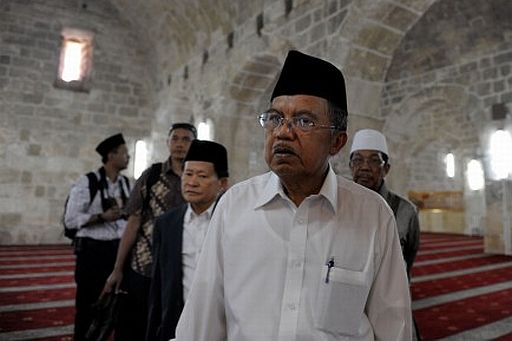
Photo : Former Indonesian Vice President Jusuf Kalla visits Al Aqsa Mosque

Former Indonesian Vice President / The Indonesian Red Cross (PMI) chairman Jusuf Kalla sightseeing Marwani Mosque, which is located on the lower side of the Al Aqsa Mosque Complex in Jerusalem, Palestine, on Friday. Jusuf visited Palestine to attend an annual meeting with the Palestinian Red Crescent. Antara / The Jakarta Post

Indonesia, Russia agree to step up ties


Russia's Foreign Minister Sergei Lavrov (R) and his Indonesian counterpart Marty Natalegawa arrive for talks in Moscow October 15, 2010. ( GETTY IMAGES / REUTERS/Denis Sinyakov )


October 16, 2010 (KATAKAMI / THE JAKARTA POST) — Indonesia and Russia have agreed to use the momentum of the 60th anniversary of their diplomatic ties to take their cooperation to a higher level, an Indonesian embassy official in Moscow said.

The Embassy’s Counselor for Social and Cultural Affairs M. Aji Surya, said in a press statement made available to Antara in London that the agreement to step up bilateral cooperation was reached in a meeting between Indonesian Foreign Minister Marty Natalegawa and Russian Foreign Minister Sergey V. Lavrov in Moscow on Friday.

Aji Surya said the two foreign ministers agreed to focus on more substantial matters in taking their bilateral relations to a higher level.

He said the two countries agreed to cooperate in the fight against terrorism, natural disaster management and air transportation sector.

The meeting also specifically discussed the possibility of opening a direct Indonesia-Russia flight route to be served by Garuda Indonesia, he said.

“The agreement on the air transportation cooperation is expected to be signed during the 17th ASEAN summit in Hanoi next week,” Aji Surya said.

According to the Indonesian counselor, the foreign minister underscored the importance of implementing the relations in all segments, not only in the government-to-government segment but also in the business sector and in the relations of peoples of both nations.

In the meantime, according to Aji Surya, Russian Foreign Minister Sergey V Lavrov expressed his commitment to facilitating the opening of an Indonesian consulate general in Russia in an effort to boost both countries’ economic and trade ties.

President Obama’s Weekly Address: GOP Rewarding Corporations that Create Jobs Overseas

The President lays out his agenda to foster investment here at home. He vows to close the tax loopholes for sending jobs and profits overseas that Congressional Republicans have tried to protect. (White House Photo, Lawrence Jackson, 10/15/10 )

WACTH THE VIDEO

October 16, 2010 (KATAKAMI  / WHITE HOUSE.GOV )  After a decade of hardship for middle class families, and a recession that wiped away millions of jobs, we are in the middle of a tough fight to rebuild this economy and put folks back to work.

Winning this fight will not depend on government alone.  It will depend on the innovation of American entrepreneurs; on the drive of American small business owners; on the skills and talents of American workers.  These are the people who will help us grow our economy and create jobs.

But government still has an important responsibility.  And that’s to create an environment in which someone can raise capital to start a new company; where a business can get a loan to expand; where ingenuity is prized and folks are rewarded for their hard work.

That’s why I fought so hard to pass a jobs bill to cut taxes and make more loans available for entrepreneurs.  It eliminated the capital gains taxes for key investments in small businesses.  It increased the deduction to defray the costs of starting a company.  And it’s freeing up credit for folks who need it.  In fact, in just the first two weeks since I signed the bill, thousands of business owners have been able to get new loans through the SBA.

But we need to do more.  So I’ve proposed additional steps to grow the economy and spur hiring by businesses across America.  Now, one of the keys to job creation is to encourage companies to invest more in the United States.  But for years, our tax code has actually given billions of dollars in tax breaks that encourage companies to create jobs and profits in other countries.

I want to close these tax loopholes.  Instead, I want to give every business in America a tax break so they can write off the cost of all new equipment they buy next year.  That’s going to make it easier for folks to expand and hire new people.  I want to make the research and experimentation tax credit permanent.  Because promoting new ideas and technologies is how we’ll create jobs and retain our edge as the world’s engine of discovery and innovation. And I want to provide a tax cut for clean energy manufacturing right here in America.  Because that’s how we’ll lead the world in this growing industry.

These are commonsense ideas.  When more things are made in America, more families make it in America; more jobs are created in America; more businesses thrive in America.  But Republicans in Washington have consistently fought to keep these corporate loopholes open.  Over the last four years alone, Republicans in the House voted 11 times to continue rewarding corporations that create jobs and profits overseas – a policy that costs taxpayers billions of dollars every year.

That doesn’t make a lot sense.  It doesn’t make sense for American workers, American businesses, or America’s economy.  A lot of companies that do business internationally make an important contribution to our economy here at home.  That’s a good thing.  But there is no reason why our tax code should actively reward them for creating jobs overseas.  Instead, we should be using our tax dollars to reward companies that create jobs and businesses within our borders.

We should give tax breaks to American small businesses and manufacturers.  We should reward the people who are helping us lead in the industries of the future, like clean energy.  That’s how we’ll ensure that American innovation and ingenuity are what drive the next century. That’s how we’ll put our people back to work and lead the global economy.  And that’s what I’ll be fighting for in the coming months.

Thank you.

Chilean President Sebastian Pinera heads for UK

President Pinera (left) is on the crest of a wave after the miners were rescued


October 16, 2010 (KATAKAMI / BBC) — Chile’s President Sebastian Pinera is due to arrive in the UK ahead of European tour, riding on the crest of a wave after the rescue of the 33 miners.

Mr Pinera will be bringing fragments of rock from the San Jose mine as presents for Prime Minister David Cameron and the Queen.

The billionaire president is due to visit Churchill’s War Rooms in London and have talks with Mr Cameron.

The rescue of the miners after 69 days has made headlines worldwide. 

Thirty-one of the miners have now been released from hospital, with the remaining two being transferred to other hospitals.

One is suffering from a dental infection and the second is suffering from the symptoms of vertigo.
Mr Pinera, 60, said Churchill’s “blood, toil, tears and sweat” speech had provided inspiration to him during the battle to save the miners.

He also said he ignored political advice to steer clear of the rescue effort: “Many people thought the rescue was impossible and advised me not to get involved, to keep my distance.
“I decided to take full responsibility without any political consideration… We made a commitment to look for the miners as if they were our sons.”

Like Mr Cameron, Mr Pinera was only elected this year, and his visit to London is thought to have been planned many months ago.

He is thought to be hoping to persuade more British companies, including mining corporations, to invest in Chile.

Mr Pinera, who greeted the miners with a hug after their rescue, told The Times: “Chile will now be remembered and recognised not for Pinochet but as an example of unity, leadership, courage, faith and success.”

He also told the newspaper he had a “very strong admiration” for Mr Cameron.

Mr Pinera will arrive at London’s Heathrow Airport later and, after sightseeing in London on Sunday, he will meet Mr Cameron and have an audience with the Queen, who has extended an invitation at the last minute following the mine rescue.

He is visiting France and Germany later this week.

Mr Pinera revealed that his father-in-law died only hours before the miners were rescued and he had told the president: “Don’t give up. Keep working to rescue the miners.”

Chile's President Gives The Queen Mine Rock

Chile's President Pinera met with the miners in hospital


October 16, 2010(KATAKAMI/ SKY NEWS) — Fresh from greeting the 33 rescued miners, Chile’s President Sebastian Pinera flies to the UK today for talks with David Cameron.

Mr Pinera told The Times newspaper he is bringing gifts of rock from the mine where the men were trapped for the Prime Minister and the Queen.

The 33 workers were all safely rescued from the San Jose mine this week and all but two have since been discharged from hospital.

The president, who was elected earlier this year, captured the world’s attention as he stood in a pit helmet ready to greet each man with a hug as they emerged.

The 60-year-old leader told The Times he was inspired by Winston Churchill’s phrase of “Blood, toil, tears and sweat” during the desperate wait for the miners’ rescue.

“Many people thought the rescue was impossible and advised me not to get involved, to keep my distance,” he said.

“I decided to take full responsibility without any political consideration… We made a commitment to look for the miners as if they were our sons.”

However, Mr Pinera’s visit to the UK comes amid news of a worker’s death at a gold mine in Petorca.
Benitez Roberto Fernandez, 26, was killed when he was hit by falling rocks.

It is the second fatal case in the region in 10 days.

Mr Pinera has vowed to improve working conditions across the nation in the wake of the rescue of the San Jose miners.

The president arrives at London’s Heathrow Airport on Saturday afternoon and will visit the British Museum and Churchill’s Cabinet War Rooms on Sunday.

On Monday he will meet Mr Cameron at Downing Street before having an audience with the Queen at Buckingham Palace.

The Harvard-educated businessman-turned-politician told The Times he hoped Chile’s international standing had been boosted by the recent rescue effort.

He aslo hoped British entrepreneurs would now invest more in his country.

“Chile will now be remembered and recognised not for Pinochet but as an example of unity, leadership, courage, faith and success,” he said.

Mr Pinera added he believed God’s help was “absolutely essential” in the successful rescue.

He described Chile and the UK as having a “real community of values” and said he hoped to forge a relationship with Mr Cameron, for whom he expressed “a very strong admiration”.

Speaking of the visit, he told The Times: “For us it’s a great honour. I am bringing with me a gift of pieces of rock taken from the depth of the mine and will give one to the Prime Minister and one to the Queen.”
Mr Pinera will also give a lecture at the London School of Economics before visiting France and Germany.

Saturday is World Food Day

Food and Agriculture Organization (FAO) Goodwill Ambassador, Indonesian singer Anggun, takes place for the celebrations of World Food Day on October 15, 2010 at the FAO headquarters in Rome. The World Food Day takes as its theme this year 'United Against Hunger.' (Photo : ANDREAS SOLARO/AFP/Getty Images)


October 16, 2010 (KATAKAMI / VOA) — Jacques Diouf , the head of the United Nations Food and Agricultural Organization, says nearly one billion people live in chronic hunger and malnutrition.
Marking World Food Day Friday at FAO headquarters in Rome, Diouf said food production needs to increase by 70 percent to meet the needs of the hungry.

Rwandan President Paul Kagame said it is unacceptable that countless people die from hunger and related diseases in a time of prosperity and unprecedented advances in science and agriculture technology.
A recent report by the FAO say 22 countries are facing long-standing hunger.

In its annual report for 2010, the FAO said aid to those countries needs to be reoriented towards longer-term solutions aimed at improving food production capacity.

Also on Friday, FAO chief Diouf announced the the deadly cattle plague, rinderpest, is showing signs that the disease will be completely eradicated by mid-2011.

He said “rinderpest affected Africa, Asia and Europe for millennia,” causing widespread famine and decimating millions of domestic and wild animals.

Australia's first saint Mary Mackillop to be canonised

Workers hang a tapestry featuring the portrait of new saint Mary MacKillop on the balcony overlooking St. Peter's Square on October 16, 2010 in Vatican City, Vatican. Pope Benedict XVI will name blessed sister Mary MacKillop known also as Mary of the Cross, as Australian first Saint in a Canonisation ceremony in St. Peter's square on next Sunday. (Photo by Giorgio Cosulich/Getty Images) 


October 16, 2010 (KATAKAMI / BBC) –  Australia’s first saint – a 19th-century nun who was briefly excommunicated is to receive official recognition.

Pope Benedict will canonise Mary Mackillop in a service at the Vatican in Rome.

Her work for the Church was sometimes controversial and in 1871 she was excommunicated for insubordination.

The Church exonerated her three years later and she was eventually put on the road to sainthood by Pope John Paul II, who beatified her in 1995.

U.S. ‘confident’ in Russia over its nuclear cooperation with Venezuela


U.S. President Barack Obama salutes while exiting Marine One at the White House October 15, 2010 in Washington, DC. Obama was attending an event for Senate candidate Chris Coons in Delaware. (Photo by Olivier Douliery-Pool/Getty Images)


October 16, 2010 (KATAKAMI / RIA NOVOSTI) — The United States will “watch closely” cooperation between Russia and Venezuela in the nuclear sphere, but has confidence in Russia regarding the observance of international nuclear non-proliferation obligations, State Department spokesman Philip Crowley said.

Russia and Venezuela signed on Friday an agreement on the construction of a nuclear power station in the South American country as part of Venezuelan President Hugo Chavez’s visit to Moscow.

The agreement was reached in April 2010 during Russian Prime Minister Vladimir Putin’s visit to Caracas.
When asked during a daily press briefing in Washington if the United States had any concerns regarding the deal – considering that Venezuela had “a little bit of ties with Iran” – Philip Crowley said “well, this is something that we will watch very closely.”

“It is certainly a right of any country to pursue civilian nuclear energy, but with that right come responsibilities and we would expect Venezuela, Russia, or any other country pursuing this kind of technology to meet all international obligations,” Crowley said, adding “the last thing we need to do is see technology migrate to countries or groups that should not have that technology.”

“But we have confidence in Russia,” he said.

Western powers fear that Iran, which is already under four sets of UN sanctions over its controversial nuclear program, may obtain advanced nuclear technologies, which would jeopardize security in the Middle East.

At Friday’s signing ceremony in Moscow, President Dmitry Medvedev said cooperation with Venezuela in nuclear field does not constitute a threat for other countries.


WASHINGTON, October 16 (RIA Novosti)

Russia agrees to build nuclear plant in Venezuela

Russian President Dmitry Medvedev (R) and his Venezuelan counterpart Hugo Chavez speak during a signing ceremony in the Kremlin in Moscow, on October 15, 2010. Moscow is the first stop for Chavez on a major international tour aimed at strengthening trade ties with several countries in eastern Europe and the Middle East, including Iran and Libya. (Photo : NATALIA KOLESNIKOVA/AFP/Getty Images)


October 16, 2010 (KATAKAMI / DDINEWS.GOV.IN) — Venezuelan President Hugo Chavez reached a deal with Russia on Friday to build the South American country’s first nuclear plant, as questions arose why a nation rich in oil and gas would feel the need to venture into atomic energy. 

The two nations also signed other energy agreements. 

Russia has cultivated close ties with Chavez’s government to expand its global clout and counter US influence in Latin America.

Russia plans to build two 1,200 megawatt nuclear reactors at the Venezuelan plant. 

The cost of Friday’s nuclear deal wasn’t immediately announced.

The deal is likely to raise concern in President Barack Obama’s administration but continues a pattern of Russia pressing to export its nuclear expertise. 

It’s talking with Indian officials about building a dozen of nuclear reactors there and also wants to build a nuclear reactor in the Czech Republic.

Russia has just completed Iran’s first nuclear power plant and recently reached new deals to build nuclear reactors in China and Turkey.

Russian President Dmitry Medvedev sought to pre-empt questions about why Venezuela would need nuclear power by saying the deal would help Caracas reduce its dependence on global market fluctuations.
“I don’t know who will shudder at this,” Medvedev said at a news conference after the signing. 

“The president (of Venezuela) said there will be nations that will have different emotions about that, but I would like to emphasise that our intentions are absolutely pure and open: We want our partner Venezuela to have a full range of energy possibilities.”

Venezuela relies on hydroelectric power for most of its electricity, and a severe drought last year and in early 2010 pushed the water level at country’s largest hydroelectric dam to perilous lows. 

The lower levels, combined with a lack of adequate upgrades to the power grid, prompted rationing measures for a time, including rolling blackouts.

Chavez says nuclear power is part of his government’s plans for diversifying its energy sources.

Chile's Pinera heads to Europe


Chile's President Sebastian Pinera (R) holds a news conference after meeting with the 33 rescued miners, outside Copiapo hospital October 14, 2010. Chile's 33 newly rescued miners recovered from their ordeal on Thursday while also pondering the celebrity status they have gained following a more than two-month entrapment deep under a remote desert. Pinera is flanked by Atacama Region Superintendent Ximena Matas and Chile's Health Minister Jaime Manalich (L). (GETTY IMAGES / REUTERS/Carlos Vera )

October 16, 2010 (KATAKAMI / SMH.COM.AU/ AFP) --- Chilean President Sebastian Pinera begins a trip on Friday to Britain, France and Germany, as he basks in the glory of the spectacular rescue of 33 miners trapped for more than two months.

Pinera travels first to London, where he will meet British Prime Minister David Cameron and stay until Tuesday, an official with the presidency told AFP.

He then goes to Paris, where he will stay until Thursday and meet President Nicolas Sarkozy. After that he heads to Berlin, where he will meet German Chancellor Angela Merkel. The trip wraps up on Saturday.
No further details of the trip have been released - neither the foreign ministry nor the president's office have handed out an official travel agenda.

Officials however said that any agenda will likely have last-minute changes because Pinera has received so many requests for interviews from foreign media to talk about the miners.

"Undoubtedly," Chilean Foreign Minister Alfredo Moreno said, the rescue of theminers "will be a much discussed topic".

As gifts, Pinera will be taking bags containing rocks from inside the mine along with copies of the initial hand-written message from the miners telling rescuers that they had survived the accident and were fine, according to the local magazine Que Pasa.

A sentence printed on each bag will read: "In your hands are rocks from the depths of the earth and the spirit of 33 Chilean miners," the magazine said.

Pinera linked himself closely to the rescue early in the operation. He travelled to the San Jose mine in far northern Chile, where the men were trapped, six times to oversee operations.

He then stayed at the site for 22 hours as the miners were rescued one by one, and hugged the miners as they left their rescue capsule. Later he visited the rescued miners in the hospital.

Meanwhile, 31 of the 33 miners were back home on Friday after doctors gave them the all clear to pick up their lives again.

Regional health director Paola Neumann said the two remaining miners, who were not named, had been transferred to clinics for more treatment, one for dental surgery, the other suffering from spells of dizziness.

The 28 miners were driven discreetly from the hospital in the northern mining town of Copiapo without stopping to speak to a horde of journalists camped outside hoping for interviews.

NATO helped bring Taliban official to Kabul: Gen. Petraeus


U.S. Army General David Petraeus addresses member of the Royal United Services Institute (RUSI), in central London, October 15, 2010. (Reuters/Dan Kitwood/Pool )


October 15, 2010 . (KATAKAMI / Reuters) - NATO-led forces facilitated the passage of a senior Taliban commander to Kabul to hold talks with the Afghan government, the commander of U.S. and NATO troops in Afghanistan said on Friday.

General David Petraeus, commander of the International Security Assistance Force (ISAF), said the move was part of U.S. and NATO support for President Hamid Karzai's reconciliation discussions with the Taliban.

"In certain respect we do facilitate that, given that, needless to say it would not be the easiest of tasks for a senior Taliban commander to enter Afghanistan and make his way to Kabul if ISAF were not....aware of it and therefore allows it to take place," he told an audience in London.

"That's about as far as I can go on that at this point."

Petraeus said several "very senior" Taliban leaders had reached out to the Afghan government and other countries engaged in Afghanistan. However, he said the discussions were preliminary in nature.

"They certainly would not rise to the level of being called negotiations," he said.

U.S. and NATO leaders said on Thursday they were ready to help Afghan President Hamid Karzai pursue reconciliation efforts with the Taliban. Pakistan said on Friday it was willing to assist such talks.