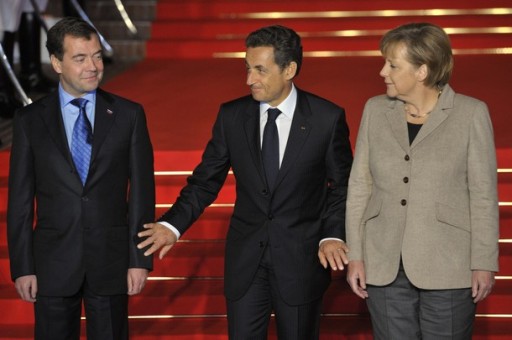
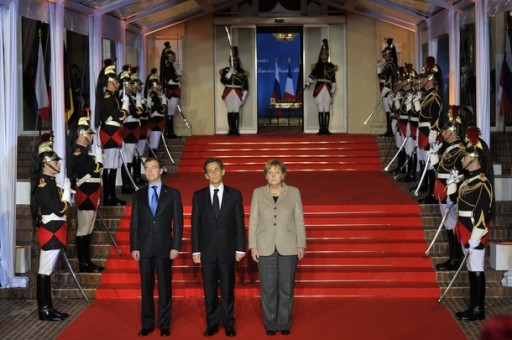
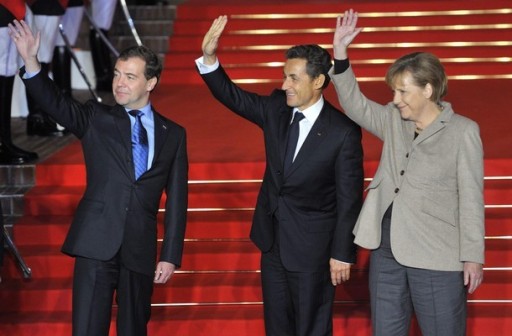
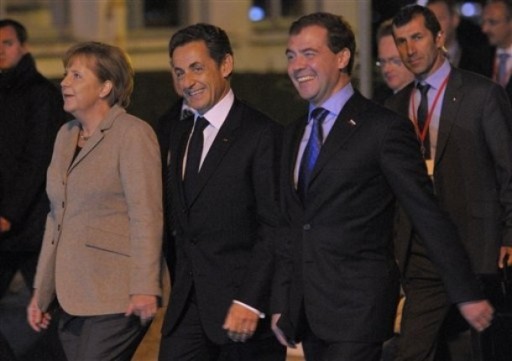
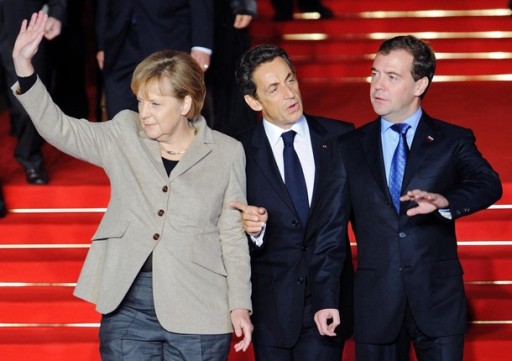
- France's President Nicolas Sarkozy (C), German Chancellor Angela Merkel (L) and Russia's President Dmitri Medvedev wave as they leave the hotel before a tripartite summit between France, Germany and Russia in Deauville October 18, 2010. (Getty Images / REUTERS/Eric Feferberg/Pool )
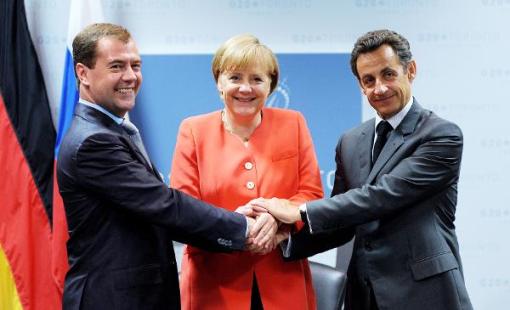
DEAUVILLE, October 18 (KATAKAMI / Itar-Tass) -- Russian President Dmitry Medvedev arrived in Deauville on Monday, October 18, for a summit meeting with German Chancellor Angela Merkel and French President Nicolas Sarkozy.
The leaders will begin their discussion at a working dinner and then continue it on Tuesday morning. They will speak about its results at a press conference.
“The trilateral meeting is not some kind on an exclusive club for working out decisions separately from other states and international organisations, but a convenient format for comparing our common vision in a confidential and frank atmosphere with our closest partners in Europe with which our cooperation is very big,” Prikhodko told Itar-Tass.
“We are for the continuation of any useful format. In the opinion of the Russian side, this troika format is useful as an addition to regular Russia-EU, G8 and G20 summits,” the Kremlin official stressed.
He cited as an example of such informal summits the Weimar Triangle (France, Germany, Poland) and the Visegrad Four (Poland, Slovakia, Hungary and the Czech Republic).
Prikhodko added, “Medvedev plans no separate meetings in Deauville.”
He recalled that the initiative to create the Russian-German-French mechanism of interaction emerged in March 1998 at an informal meeting of the heads of the three countries. The main task of the troika then was “to promote the development of a multi-polar world excluding the possibility of dominance by any single power.”
The first such summit was held in Strasbourg in 1998 with the participation of Russia's first President Boris Yeltsin. After that the troika gathered in 2003, 2004 and 2005. Vladimir Putin represented Russia at those meetings.
“We are, certainly, ready for the continuation of such meetings (after Deauville), it is an additional opportunity for us to discuss vital issues without protocol,” Prikhodko said. He did not answer a question why the troika has had a five-year interval in the meetings, and only said that the leaders had decided to gather when everybody was ready for it. “We are interested to continue such meetings,” he said.
“High on the agenda of the summit in the Group of Three format are prospects for building a democratic space of equal and indivisible security in the Euro-Atlantic region and Eurasia that should match modern political realities and give joint responses to common threats and challenges,” Prikhodko said.
Russia “gives priority to the promotion of the initiative, which President Dmitry Medvedev put forward in 2008 to draft a new European security treaty,” he noted.
The Russian leader said earlier in the day, “Jointly with my colleagues - French President Nicolas Sarkozy and German Chancellor Angela Merkel, we will discuss security in Europe.”
“I'd like to recall that my idea regarding the signing of a new European security treaty is aimed at this. I'd like this treaty and other efforts taken by our country in the field of security to receive a worthy response in the world,” he stressed.
According to Medvedev, “security is important not only for Europe but also for the Asia Pacific Region, for Africa and for America.” “That is why we will continue our efforts in all directions. The task, which is aimed at promoting this international agenda and improving security institutions, is correlated with modernisation of our country, our economy and our political system,” he emphasised.
“The purpose of this approach is to overcome the stereotypes and give up previous mentality. I believe that we have succeeded in doing this. Our contacts with the United States of America, Russian-Polish relations, the signing of the Russian-Norwegian border deal in the Barents Sea and other political events testify to this,” he said.
Medvedev also said, “Modern international relations should develop on a democratic basis. Recently I've spoke about this at the forum in Yaroslavl where I spelled out my vision on democratic standards.”
The summiteers “will share opinions on the Iranian nuclear problem, primarily in line with the development of positive tendencies that are taking shape after the meeting of the Sextet foreign ministers in New York,” Prikhodko underlined. Alongside, Prikhodko added that the resumption of the Sextet negotiations on the Iranian nuclear problem could hardly be discussed in practical terms at the summit of the leaders of Russia, France and Germany. “We cannot take separate isolated decisions. This is not a prerogative of the Group of Three,” he elaborated.
“Medvedev, Sarkozy and Merkel are expected to come out in support of the direct Palestinian-Israeli dialogue,” the Kremlin official said.
The Deauville summiteers “will also discuss preparations and will synchronise the positions ahead of forthcoming major foreign political events - an OSCE summit (Astana, December 1-2) and a Russia-EU summit (Brussels, December 7),” Prikhodko added.