Tampilkan postingan dengan label South Korea. Tampilkan semua postingan

10/22/2010

G20 finance ministers meet in South Korea


South Korean Finance Minister Yoon Jeung-hyun (R) shakes hands with U.S. Treasury Secretary Timothy Geithner during a meeting ahead of the G20 Finance Ministers and Central Bank Governors meeting in Gyeongju, southeast of Seoul, October 22, 2010. G20 officials are unlikely to reach an accord rejecting currency devaluations and capping current account balances, an informed source said on Thursday, after U.S. proposals ran into stiff opposition. (GETTY IMAGES / REUTERS/Finance Ministry/Handout )
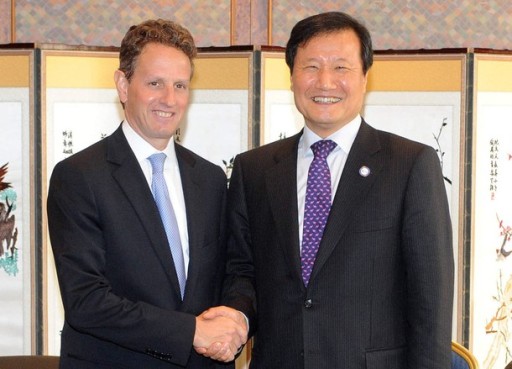

October 22, 2010 (KATAKAMI / BBC) --- Finance ministers from the G20 leading economies are meeting in Gyeongju, South Korea, ahead of a summit by heads of state and government next month.

Continuing tensions over exchange rates are likely to dominate proceedings.

China is resisting pressure to allow the yuan to appreciate significantly, and many developing countries also fear a currency rise could hit exports.

Low interest rates in wealthy countries have encouraged investors to seek better returns in emerging economies.


Common approach

The G20 is trying to find a co-ordinated path out of the financial crisis.

Perhaps their most immediate challenge now is to agree a common approach to the problems in the currency markets.

All the signs are that the finance ministers will struggle to make significant headway.

Many developing countries are concerned about upward pressure on their currencies, which could make their exports less competitive.

Behind that pressure are very low interest rates in rich countries, which have led investors to seek better returns in emerging economies. That tends to push the currencies higher.

China has resisted this upward pressure on the yuan by buying dollars.


South Korean President Lee Myung-bak (r) talks with World Bank President Robert Zoellick in Korea
There is a widespread desire in the G20 to see China cut back on currency intervention

That exacerbates the problem for other countries that compete with China.

There is a widespread desire in the G20 to see China cut back on the intervention and allow the yuan to rise, expressed most forcefully by US officials.

But China shows no inclination to make much of a move in the near future.

The other factor behind the currency tension - the low interest rates in rich countries - is also unlikely to change soon.

It is a result of their faltering economic recoveries.

Indeed, there are signs that central banks in the US and UK might take further steps to simulate recovery, which could lead to still lower interest rates and even more money flooding into emerging economies, further aggravating the currency tension.

10/18/2010

N. Korea’s nuclear program ‘biggest threat’ to region: South Korean Joint Chiefs of Staff


FILE : General Han Min-koo (R), new chairman of South Korean Joint Chiefs of Staff, inspects an honour guard during a welcoming ceremony for General Han at a U.S. military base in Seoul July 8, 2010. (Getty / REUTERS/Jo Yong-Hak )

SEOUL, Oct. 18 (KATAKAMI / Yonhap) -- North Korea's nuclear weapons program poses the most serious threat to the security of the Asia-Pacific region, South Korea's top military officer said Monday.

"North Korea's nuclear program, as well as its weapons of mass destruction, is the biggest threat" to regional stability, Gen. Han Min-koo, chairman of the South's Joint Chiefs of Staff (JCS), told reporters at an annual conference of military leaders in Seoul.

It was not clear whether Han's remarks were based on the recent reports of fresh activities close to the North's main nuclear complex Yongbyon.

Officials at the JCS declined to elaborate on the comments by Han, who also cited territorial disputes and pirates in Southeast Asia as security threats to the region.

Recent satellite images by the U.S.-based Institute for Science and International Security showed construction activity near a cooling tower at Yongbyon, which the North blew up in 2008 as a show of its commitment to denuclearization.

North Korea has signaled that it was ready to rejoin the long-suspended six-party talks on its denuclearization, but its motive remains unclear with images suggesting it might be preparing to restore the plutonium-producing facility.

During the conference, Han said South Korea's military would forge closer cooperation with its U.S. and Japanese counterparts to share intelligence on the North's nuclear program.

North Korea, believed to have enough weaponized plutonium for at least a half dozen bombs, declared it was quitting the six-party talks in April last year and conducted its second nuclear test a month later.

South Korea is hosting the five-day Chiefs of Defense conference this week, with participants including U.S. Pacific Command Commander Robert Willard and Gen. Ryoichi Oriki, Japan's chief of joint self-defense forces.

The conference drew dozens of senior defense officials from 27 countries in the Asia-Pacific region. Coordinating ways to improve civilian-military cooperation at international peacekeeping missions and global collaboration on maritime security are among the topics on the agenda for the meeting that ends Friday, Seoul's military officials said.

10/07/2010

US, South Korean Diplomats Discuss Power Shift in North

US Assistant Secretary of State for East Asian and Pacific Affairs Kurt Campbell, right, speaks to the media after meeting with South Korean Deputy Foreign Minister Kim Jae-shin, left, in Seoul, 7 Oct. 2010.


October 07, 2010 (KATAKAMI) --- A top-ranking U.S. diplomat says Washington and Seoul need to "remain in lockstep" to respond to any developments on the Korean peninsula. Kurt Campbell's meetings with South Korean officials come as Pyongyang shows signs that preparations for a power transfer are under way.

Assistant Secretary of State Kurt Campbell repeated the U.S. position that Pyongyang needs to improve relations with Seoul before international talks about dismantling North Korea's nuclear weapons programs can resume.

"The first step, as we've said, has to be re-engagement between North Korea and South Korea,
Campbell said. "I think we're also looking for a clear and demonstrable commitment on the part of the North Koreans to fulfill their commitments that they have made on denuclearization in 2005."

North Korea has recently suggested several levels of talks with South Korea.

Campbell spoke Thursday following talks with South Korean diplomats that he says focused on last week's party congress in North Korea. The rare conference gave powerful posts to Kim Jong Un, the youngest son of absolute leader Kim Jong Il. The posts apparently are to prepare him to succeed his father.

Official North Korean media Thursday reported the younger Kim attended a concert with his father. It is the second reported public appearance this week for the young man, who until recently was almost never seen.

South Korea's Unification Minister says the move toward a power succession in Pyongyang adds to uncertainties about what is happening in North Korea.

Earlier this week, a South Korean presidential security advisor termed the nuclear threat from the North to be at an "alarming level."

Recent satellite photos suggest North Korea may be preparing to restore some operations at its Yongbyon nuclear complex.

The reactor, which produced weapons-grade plutonium, was shuttered three years ago under an international agreement. North Korea has since renounced the deal and threatened to resume operations. Last year, the reclusive impoverished country said its uranium enrichment experiments were in the final stages. Enriched uranium is used for weapons.

There have been on and off negotiations, involving both Koreas, China, the United States, Japan and Russia, since 2003 concerning the North's nuclear weapons programs.

The two Koreas remain technically at war since their civil war halted in 1953 without a peace treaty.

Relations between the two governments have been tense for more than a year. They worsened further in late March when a South Korean naval vessel exploded and sank. An international investigation blamed a North Korean torpedo. Pyongyang denies any responsibility and rejects Seoul's repeated demand it apologize for the sinking as a prelude to improving ties.


VOA