Tampilkan postingan dengan label Palestine. Tampilkan semua postingan

10/29/2010

Report: Israel, U.S. discuss land lease

http://www.crossed-flag-pins.com/Friendship-Pins/Israel/Flag-Pins-Israel-Palestine.jpg
JERUSALEM, Oct. 29 (KATAKAMI / UPI) -- Israel and the United States are conducting secret talks on future borders of a Palestinian state, Ash-Sharq al-Awsat reported Friday.

"We are conducting intense negotiations with the U.S. administration in an effort to resume direct talks with the Palestinians," Ophir Gendelman, head of Israel's Foreign Ministry Arabic media department, told the Arabic daily.

The two sides are discussing the option that Israel will lease land in East Jerusalem and the Jordan Valley from the future Palestinian state for 40 to 99 years, the report said.

The report was confirmed by Palestinian sources, who said the idea was an American initiative aimed at obtaining an understanding with Israel over the future Palestinian state, Haaretz said.

The sources said the talks are being conducted in secret in an effort to save the peace process.

The Israeli daily said U.S. and Israeli government officials declined to comment on the report.

An Egyptian source told Ash-Sharq al-Aswat the Palestinian Authority was informed only recently of the substance of the talks.

(MS)

10/26/2010

Mahmoud Abbas: Israel has been taking unilateral measures for years


Palestinian Authority president responds to Netanyahu's criticism of Palestinians possibly seeking UN recognition of state; "settlements are a unilateral step done by Israel," Abbas says.
October 25, 2010 BETHLEHEM, West Bank (KATAKAMI / JPOST)   — Palestinian Authority President Mahmoud Abbas said Monday that Israel has been taking unilateral steps for decades by building settlements, so the Palestinians might take one of their own — asking the United Nations to recognize their independent state.

Abbas was replying to Prime Minister Binyamin Netanyahu, who said the only path to peace is negotiations. The threat of unilateral action indicates the depth of the crisis over peace talks restarted just last month by US President Barack Obama.

Israeli settlements in the West Bank are at the heart of the current stalemate. Netanyahu imposed a 10-month halt to new construction in settlements last November to bring Palestinians back to the table. But it took nine months of intensive US mediation to restart direct talks.

Netanyahu faced stiff opposition to the building restrictions from inside his government and said he would not renew the measure, which expired Sept. 26. Construction has begun on more than 500 new homes since then, according to settler officials and a count by The Associated Press.

Palestinians insist they will not hold talks while settlement construction continues. They have been suggesting recently that they would seek other solutions if the talks fail.

One possibility would be asking the United Nations to recognize a Palestinian state in the West Bank, Gaza Strip and east Jerusalem, territories Israel captured in the 1967 Mideast war.

That would not dislodge the Israeli military from the West Bank, dismantle the 120 Jewish settlements there or give Palestinians free access to east Jerusalem. But it could isolate Israel and change the diplomatic equation.

On Sunday, Netanyahu criticized this idea.

"I think any attempt to circumvent it by going to international bodies isn't realistic and won't advance true peacemaking in any way," Netanyahu said. "Peace will be achieved only through direct talks."

During a visit to Bethlehem on Monday, Abbas responded that Israel has been taking unilateral measures in the West Bank for decades — especially by building settlements.

"Settlements are a unilateral step done by Israel," Abbas said. "Is there anything clearer than settlements and invasions and roadblocks and all that has been done on Palestinian land?"

Given that reality, Abbas said, Netanyahu should not lecture the Palestinians about a step they might take in the future, "which is to resort to the United Nations."

Palestinian officials have mentioned this possibility before, but Abbas' statement was a rare on-the-record reference to the idea.

10/11/2010

French, Spanish FMs meet with King Abdullah, Abbas

President Mahmoud Abbas & King Abdullah II


October 11, 2010 (KATAKAMI) --- French Foreign Minister Bernard Kuchner and his Spanish counterpart Miguel Moratinos meet in Amman with Palestinian President Mahmoud Abbas and Jordan's King Abdullah. 

The European ministers, who met with Israeli officials on Sunday, expressed optimism vis-à-vis the peace process, and noted that they believed Europe could assist the process, especially Spain and France. 


(YNET / AFP)

Abbas told Arab summit Israel has 'cancelled Oslo': aide


President Mahmoud Abbas attends Arab League Summit, October 09, 2010 in Sirte, Libya. (Getty Images)


October 11, 2010 (KATAKAMI / FRANCE 24 / AFP)  - Palestinian leader Mahmud Abbas told Arab leaders over the weekend that Israel has in effect scrapped the landmark 1993 Oslo autonomy accords, an aide said on Monday.

"Abbas affirmed to the Arabs that Israel has effectively cancelled the Oslo agreement and the other agreements it has signed with the Palestine Liberation Organisation (PLO)," chief negotiator Saeb Erakat told AFP.

He went on to accuse Israel of having stripped the Palestinian Authority of much of its limited powers in the occupied territories and of "intruding on a daily basis" into areas governed by the Palestinians, Erakat said.
"If Israel does not respect agreements or adhere to implementing them then how can the PLO and the Palestinian Authority adhere to them?" he asked.


The 1993 Oslo accords formally launched the peace process based on autonomy and led to the creation of the Palestinian Authority, which was to govern parts of the occupied West Bank and Gaza until a final agreement.

But after nearly two decades of sputtering talks Israel and the Palestinians remain bitterly divided on core issues and Abbas has refused to negotiate without a complete freeze of Jewish settlement building on Palestinian lands.

Erakat said that Abbas, at the Arab summit in the Libyan city of Sirte, also spelled out several alternatives to direct negotiations should Israel continue to build in the occupied territories.

One option would have the Palestinians demand US recognition of a state in the Palestinian territories occupied in the 1967 Arab-Israeli war: the West Bank, Gaza Strip and annexed Arab east Jerusalem.

Abbas said other options include demanding full membership from the UN General Assembly and the Security Council or requesting an international mandate to govern the Palestinian territories, Erakat said.

"Abbas did not say he would resign or dissolve the Palestinian Authority," Erakat said, referring to far more drastic steps to which the Palestinians have alluded in the past.

"But he said that since Israel has cancelled the Oslo accords and the other agreements and stripped the power of the Palestinian Authority over Palestinian lands, why should it remain in place?"

The latest round of peace talks was relaunched on September 2 in Washington but ground to a halt when a 10-month partial moratorium on Israeli settlements expired on September 26.

Israel's Prime Minister Benjamin Netanyahu has refused to extend the restrictions, a move opposed by much of his right-wing-led coalition, but he has encouraged the Palestinians to stick to the talks.
Click here to find out more!

10/09/2010

To restart peace talks, Israeli, Arab leaders look for compromise

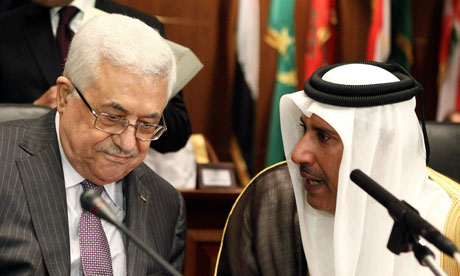
Palestinian president Mahmoud Abbas (left) listens to Qatari foreign minister Sheikh Hamad bin Jassim al-Thani during a meeting of the Arab League yesterday. Photograph: Khaled Desouki/AFP/Getty Images


October 09, 2010 (KATAKAMI) --- Israeli and Arab leaders Friday continued to search for a compromise that would allow peace talks to continue this weekend, but both sides acknowledged that the current negotiations were making no progress.

As Israeli Prime Minister Benjamin Netanyahu sought consensus within his Cabinet, possibly for a brief extension to the expired settlements freeze, the Arab League announced it was drafting alternative plans for continuing the peace talks.

"We will meet to formulate the beginning of alternatives within the framework that the negotiations are not bearing fruit," said Arab League Secretary-General Amr Moussa, after a meeting Friday in Libya.
Anonymous officials quoted in the Arab news media said Arab countries would allow up to one month to search for alternatives, effectively delaying a decision amid international pressure for the peace talks to press forward.

The Arab League had been expected to vote on the position of Palestinian Authority Chairman Mahmoud Abbas to suspend the talks until Israel agreed to freeze all construction in the West Bank settlements.
Egypt and Jordan had already decided to back Abbas' position, but Moussa said the Arab League would take more time to continue to find compromises.

"There are no talks at the moment because the position of the Israelis is very, very negative. They are not cooperating in the negotiations," Moussa said.

The apparent decision by the Arab League represents a small victory for U.S. Mideast peace envoy George Mitchell - buying him time to try to find a way for the direct talks to continue.

Israel's most recent, 10-month freeze on settlements expired Sept. 26. For much of that time, Israeli and Palestinian leaders held indirect "proximity" talks, mediated by Mitchell.


President Mahmoud Abbas & PM Netanyahu in Washington (September 2, 2010)


Israeli and Palestinian leadership had agreed to start direct negotiations with great fanfare at the White House on Sept. 2.

But the looming end to the settlement freeze cast a shadow over the talks before they got under way. As settlers celebrated the end of the freeze by launching hundreds of building projects in the West Bank, Palestinians confirmed that they would not begin to meet to talk peace until that building stopped.

Settlements have long been a major stumbling block in peace negotiations.

Palestinians see them as a land grab by Israel. Palestinian negotiator Saeb Erekat has stated repeatedly that it is "pointless" for Palestinians to continue negotiations while settlements continue to expand on land earmarked for a future Palestinian state.

Israel, meanwhile, remains torn on the settlements with a recent poll by the Israeli company Dahaf finding that 54 percent of Israelis support their continued growth. Netanyahu, meanwhile, heads a largely right-wing coalition that is close to the settler movement.

While a number of Israeli lawmakers have spoken out in support of the settlements, few within Netanyahu's inner Cabinet have agreed to speak publically about the behind-the-scenes negotiations to reach a compromise.


Israeli news media reported that the White House was putting "significant" pressure on Netanyahu, and had offered him a package that would include key security promises in exchange for extending a freeze on the settlements.

"We are considering a number of options at the moment, and are in daily communication with both the U.S. and other parties who want to be involved in the peace process," said one Israeli official, who spoke anonymously because he was not authorized to discuss the negotiations.

He confirmed that several compromises had been suggested that would institute some form of a freeze on settlement construction for "a limited time." Abbas has said that a "three- to four-month" freeze would be necessary to "give peace a chance."

KANSASCITY.COM

Arab League urges US to call halt on Israeli settlements


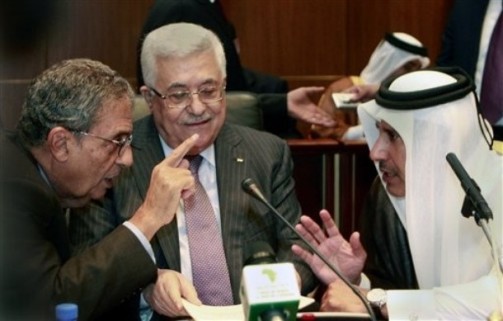
Palestinian President Mahmoud Abbas, center, listens to Qatar's Foreign Minister Sheik Hamad Bin Jassem, right and Amr Moussa, Secretary general of the Arab League, during the Arab Foreign Ministers Peace Initiative meeting, in Sirte, Libya, Friday, Oct. 8, 2010. (Getty Images)


October 09, 2010 (KATAKAMI) -- Arab foreign ministers have given the US another month to persuade Israel to halt settlement activity in the occupied territories – backing the decision by Palestinian president, Mahmoud Abbas, to suspend peace talks.

Talks in Libya produced a statement by the Arab League last night urging the Obama administration to carry on working for an extension of Israel's 10-month settlement freeze, which expired last month, so that the already faltering negotiations can continue.

Abbas had urged ministers of the 22-member league to back his call for more time before pronouncing the talks a failure, as many observers predict they eventually will be.

Qatar's foreign minister, Sheikh Hamad bin Jassim al-Thani, who chaired the meeting in the coastal town of Sirte, told reporters: "The committee endorses the decision of President Abbas to stop the talks. It urges the American side to pursue efforts to resume the peace process and put it back on the right track, including stopping settlements."

The league committee will meet again within one month to study alternatives proposed by Abbas.
The effect of the Arab decision is to allow the quest for negotiations to go into extra time despite what had appeared to be an early and potentially terminal crisis over the ever-intractable settlement issue.

Direct Israeli-Palestinian peace talks were ceremonially relaunched early last month in Washington and just two working sessions were held in Egypt and Jerusalem before the expiry of the settlement moratorium.
The US has urged Israel to extend it, but the prime minister, Binyamin Netanyahu, has refused to do so, arguing that the housing needs of Jewish settlers were simply a matter of "natural growth" and blaming the Palestinians for making an unreasonable demand.

Abbas and other Palestinian officials had made clear they would not be able to carry on negotiating with Israel without an extension of the freeze, even for two or three months.

Palestinians see the presence of 500,000 Israelis in some 120 settlements in the West Bank and East Jerusalem as a threat to the viability of their future state and a freeze as a key test of Israel's good faith.

Diplomats and analysts say that while both sides are deeply pessimistic about prospects for success, neither wishes to be blamed for the collapse of the peace process. That would be a grave blow to US prestige and risk political chaos and a possible slide into violence on the ground.

"There are no talks at the moment because the position of the Israelis is very, very negative," said the Arab League's Egyptian secretary-general, Amr Moussa. "They are not cooperating in the negotiations."

Abbas's position was backed by Egypt and Jordan, which both have peace treaties with Israel, as well as Saudi Arabia and most Gulf states, which do not. But Libya and Syria have reservations. Syria's foreign minister, Walid al-Muallem, conspicuously stated away from the Sirte meeting.

In the West Bank town of Hebron, meanwhile, Israeli troops shot and killed two Palestinians who were described as members of the military wing of Hamas, the Izzedine al-Qassam Brigades. The two were reportedly part of the cell responsible for an attack which killed four Israeli settlers on the eve of the relaunch of the talks.


GUARDIAN.CO.UK